-
Is the Fully Jarvis still worth buying?
-
When does a Fully Jarvis L-shaped standing desk actually make sense?
-
What do Fully Jarvis bamboo standing desk reviews leave out?
-
How do I check whether an L-shaped desk fits before I order?
-
Can I use a Jarvis as a craft-room desk rather than an office desk?
-
What's the one check that prevents most order emergencies?
I'm the person who gets the panicked call when a standing desk order has to happen faster than normal—or when a desk arrives and doesn't work in the space. In my role coordinating office-furniture installs, I've been part of 250+ Fully Jarvis deliveries over the last four years, including more than a few rush setups that turned into same-day fixes. What stands out to me is this: most of those emergencies weren't product problems. They were checking problems.
If you're reading Fully Jarvis reviews because you're thinking about the L-shaped version or the bamboo top, this FAQ is the conversation I'd have with you before you order. Call it the stuff that usually gets discovered the hard way.
Is the Fully Jarvis still worth buying?
Yes, with one caveat: it's worth it if you'll actually change positions during the day. I don't have hard data on how many people stop using the standing feature after a few months, but based on the setups I visit, the owners who use memory presets and set reminders are the ones who stay happy with it. If you buy a Jarvis mainly because it looks sleek and never raise it, you're paying for a feature you'll ignore.
Because of the Herman Miller relationship, a lot of people ask whether the Jarvis is just coasting on a well-known name now. I can only speak to what we see from the receiving end: the boxes, hardware, finish, and general build have been consistent in our recent orders. I'd still recommend it. I also would tell someone not to buy it if they don't actually need a sit-stand desk. A simpler desk will do the same job for less.
When does a Fully Jarvis L-shaped standing desk actually make sense?
An L-shaped Jarvis makes sense when you have a corner and you genuinely use two zones. For example, a computer zone on one side and a writing, reading, or meeting zone on the other. It keeps things within arm's reach so you don't have to spin or roll across the room every time you switch tasks.
The version I see people regret is the "more desk must be better" version. L-shaped desks eat floor space quickly. If the room is narrow, if you need to face someone, or if a straight desk would leave better clearance for your chair, the L-shape can become a problem instead of an upgrade. I'd rather fit a straight 60-inch desk with comfortable movement around it than cram an L-shape into a room that can't breathe.
What do Fully Jarvis bamboo standing desk reviews leave out?
Most reviews get the look right. A bamboo top warms up an office and gives Jarvis a slightly softer feel than a standard laminate. What most reviews don't emphasize enough is care. Bamboo is a grass, not a sealed plastic surface; water rings, ink, and direct blade contact are all things to avoid. In my experience, the buyers who treat a bamboo desktop like a kitchen cutting board are the same ones who call us later asking if the surface can be repaired.
For a busy shared office or a workspace where you'll be cutting, gluing, or using craft materials, laminate is often the smarter choice. For a home office where you use a desk pad and coasters, bamboo is lovely. So when you see a review saying the bamboo version is beautiful, believe it. If you see one saying "scratch-proof" or "maintenance-free," don't. Those words don't belong to any natural surface.
How do I check whether an L-shaped desk fits before I order?
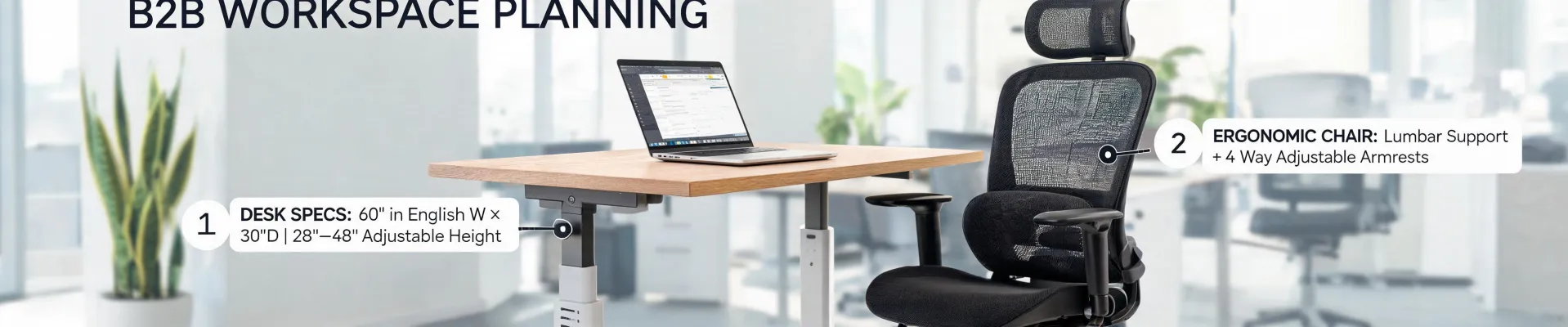
The desk footprint is only half the question. You also need to check the route to the room, the door swing, the outlet locations, and whether the frame's footprint will clear the baseboard or a floor duct. I can't tell you how many L-shaped orders looked perfect on paper but ended up with a leg base directly over a floor outlet.
Here's a low-tech trick I use all the time: I have a free graph paper printable bookmarked. Draw the room with each square representing one foot, then draw the desk's actual footprint in it—including the return you're considering. You'll see overlaps that don't show up when you're just looking at product photos. It takes ten minutes and prevents a lot of long, expensive returns.
Can I use a Jarvis as a craft-room desk rather than an office desk?
Yes. Some of my favorite installs are not offices at all. One customer runs a small stationery business from a spare bedroom: a Jarvis L-shaped desk with a sticker printer on one side, her laptop in the middle, and a cutting mat area on the other. She switches between sitting and standing depending on whether she's designing or packing orders.
If your creative work involves polymer clay—and if you're wondering what is polymer clay, it's an oven-hardening modeling material, not the air-dry kind—keep it on a ceramic tile or a self-healing mat. Unbaked clay can be oily, and some pigments will leave marks on a light bamboo surface. That's not a Jarvis flaw; it's true of any wood or bamboo top. For heavy-duty craft use, I'd pick a laminate top or just protect the surface and move on.
What's the one check that prevents most order emergencies?
The delivery route. You can measure the office or home office perfectly, but if the desktop can't get from the receiving area to the room, it doesn't matter. Old elevators, narrow stair turns, and long corridors are the things we deal with after the fact, and they're awkward to fix when the install crew is already on site.
Before you order, ask for the packed dimensions and compare them to the route. If an L-shaped desktop has to go up two flights of stairs with a turn at the landing, you need to know that before the desk is on a truck, not after.
The same thinking applies to the whole setup: five minutes of verification beats five days of correction. I learned that the expensive way in 2023, and it's now the first thing I tell anyone in a hurry.
