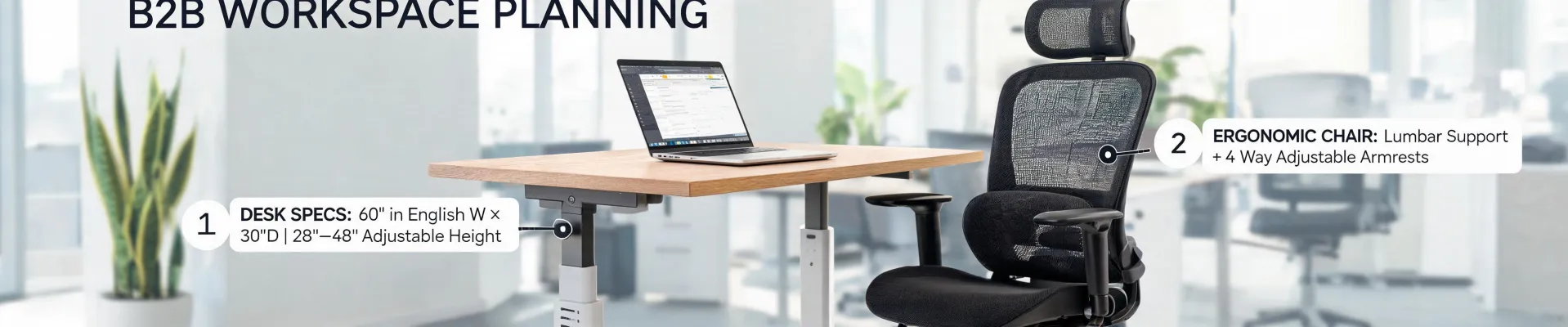
Last spring, I sat in a budget review while our VP pointed at one line in the furniture spreadsheet. 'This Fully Jarvis quote is $370 more than the other standing desk,' he said.
He wasn't wrong. He was looking at the wrong column.
Why the sticker price is the wrong number
I run procurement for a 48-person architecture firm. Over the past six years, I've managed an annual facilities budget of about $450,000, negotiated with more than 30 office furniture vendors, and logged every purchase in our cost system. I mention that because I'm not the kind of buyer who gets seduced by beautiful wood. My default is skepticism.
By bid price alone, the Fully Jarvis hardwood standing desk doesn't win. A basic standing desk frame with a laminate top will almost always quote lower. But a workstation doesn't cost only what you pay on delivery. It costs what you spend to keep it working for the people who use it every day.
A $300 difference sounds big until you spread it over a year of real use. One full-time employee spends roughly 2,000 hours at a desk in a year. That's 15 cents an hour. Compare that to the cost of one ergonomic complaint, one repair visit, or one lost afternoon of work. You don't need a huge productivity gain to make the difference irrelevant.
The real problem is hidden in your spreadsheet
The deeper issue isn't the desk. It's the way office furniture decisions get made. Facilities buys the desk. HR pays for the health effects. Operations pays for the mistakes, absences, and slowdowns caused by discomfort. When those budgets don't talk to each other, the only number anyone sees is the purchase price.
That leads to a predictable outcome. We compare a $700 option with a $1,000 option and call the difference 'savings.' But the comparison ignores everything that happens after day one:
- Cheaper tops are more likely to chip, and a printed laminate surface usually can't be repaired. A hardwood surface has a much better chance of being maintained over time.
- Cheaper frames often have less height range. If the frame can't adjust low enough for a shorter employee or high enough for a taller one, it's just a fixed desk with a motor on it.
- Cheaper support usually means slower lead times for replacement parts. When a desk fails, you're not just buying a part. You're losing workdays.
None of those items show up in the initial quote. But they all show up in the operating budget eventually.
The pilot that changed my spreadsheet
I've been burned by this before. In 2021, I was choosing between two workstation vendors. I knew I should calculate total cost instead of sticker price, but the cheaper quote looked like a clear win. We bought the cheaper option for a small pilot.
The first desk arrived with a damaged top. The replacement took four weeks. The second desk had a motor that stopped holding height after two weeks. The vendor offered to replace the motor, but they couldn't send a technician to our city. We paid a local technician $180 to do work that should have been covered under warranty.
I also knew I should verify support response times before signing. I skipped it because I thought, 'How often does a desk really break?' That was the one time it mattered.
The most frustrating part was the pattern. You'd think a written spec would prevent these issues, but poor component quality and weak support are hard to see on paper. They show up later, in repair logs and missed deadlines.
What the cheap option actually cost us
Before we switched to sit-stand workstations, 14 out of 48 employees asked for ergonomic assessments in a single year. We spent roughly $350 per workstation on keyboard trays, monitor arms, and posture aids. That money wasn't wasted, but most of it should have been unnecessary. The base desks were creating the problem.
When I added the pilot results to our cost-tracking system, the price gap between the 'cheap' desk and the better desk had nearly disappeared. The cheap option generated extra repair visits, a reorder, and several hours of IT time. In one case, it ended up costing more than the premium option.
The lesson wasn't 'always buy the most expensive thing.' The lesson was that a quote without context isn't a cost analysis. It's a hope.
Change the denominator
The solution was simple, but it required changing how we compared desks. Instead of asking, 'What's the price per workstation?', we started asking, 'What's the cost per workstation over the next five years?'
That meant evaluating shipping, installation, warranty handling, repairability, top material, and estimated lifespan. The frame wasn't the only variable. The surface material mattered too, because a hardwood surface behaves differently in a busy studio than a laminate surface does.
When we ran the numbers, the Fully Jarvis hardwood standing desk won. Not because it was the lowest quote, but because it was the cheapest to own.
If you're evaluating a Herman Miller Fully Jarvis standing desk, the brand connection matters more than the logo. Fully sits in a larger MillerKnoll family, and for a procurement person, that means somebody actually answers the phone when something goes wrong. That has real dollar value.
I'm not going to claim the Jarvis is indestructible. No desk is. But a repairable hardwood top paired with a frame from an established company is easier to maintain over five years than an unnamed import. That maintainability has to be part of the calculation.
After the switch, our ergonomic support requests dropped by more than half over six months. That's a small sample, not a clinical study. But it appeared in our internal cost tracking, and it came after a deliberate change in how we bought furniture.
So the next time a low bid lands on your desk, don't ask only what the desk costs. Ask what it will cost in year three. That question changes the answer.
