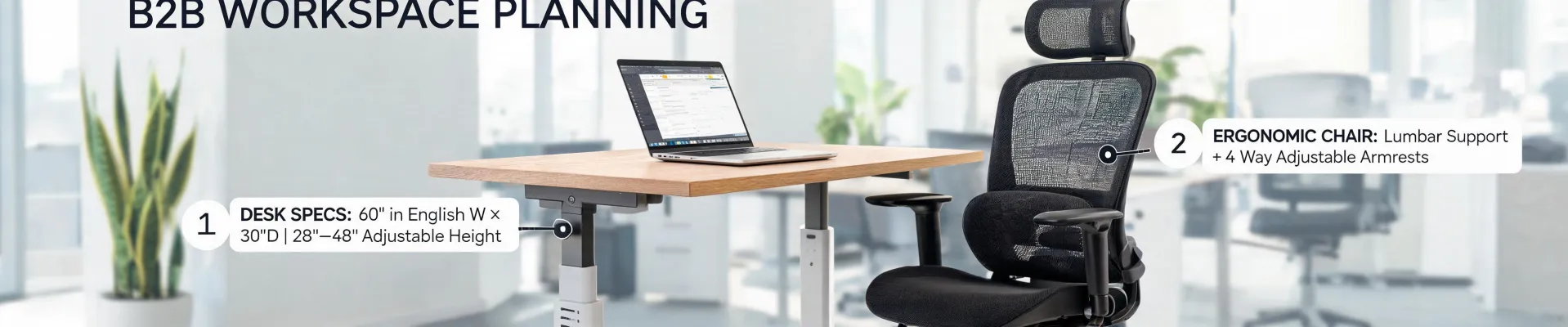
After six years of approving office furniture orders for a 140-person design firm, I now give the same answer every time someone asks whether the Fully Jarvis walnut standing desk is worth it: it depends on who is going to see it. The walnut top earns the premium in client-facing or candidate-facing rooms. For a back-office workstation, pick the bamboo Jarvis and spend the difference on something that improves people's actual work. That sounds like an interior-design opinion, but it is a cost-control conclusion based on comparing three desktop materials, handling one freight-damage claim, and watching a client say more about our office in ten seconds than any proposal could.
I am a procurement manager, not a designer. I have managed a facilities budget of roughly $480,000 a year for the past six years, and every order goes through our cost tracking system. I did not start with this view. Actually, I started as the person who ordered bamboo tops and thought a wall-mounted bulletin board would make any room feel warm enough. That works in many rooms. In a client-facing room, it does not.
What Fully Jarvis Standing Desk Aesthetics Actually Means
Search the phrase Fully Jarvis standing desk aesthetics and you will find styled photos of desks in rooms with good light. I used to write those images off as marketing. After putting a walnut Jarvis in one of our meeting rooms, I changed my mind. The aesthetic is not an extra feature. It is a signal. Clients cannot audit our workflow in a two-hour visit. They can see whether our tools are scratched or well chosen, and they draw conclusions from that.
There is also a practical difference between the desktop options. The walnut top has a darker, quieter finish than the honey-toned bamboo top. In a bright casual studio, bamboo can look perfect. In a more formal client room, walnut reads as established rather than trendy. Neither material looks cheap. The one you choose says something about the kind of company you are.
What Most Fully Jarvis Walnut Standing Desk Reviews Skip
Most Fully Jarvis walnut standing desk reviews talk about wobble, setup, cable tray, and color. All fair. Our 60 x 27 Jarvis frame felt stable enough at standing height while I typed. I am not going to say zero wobble, because that depends on the floor, the height, and how hard someone leans. Assembly was manageable, with no big surprises.
The part most reviews miss is freight. The desktop ships as a separate piece, and wood can arrive with edge damage if the carton is handled badly. One of our first walnut desktops had a small mark on a corner. We filed a claim and got a replacement in about a week. That kind of detail does not show up in glossy review photos. It still matters for budgeting.
Where the Premium Desktop Earns Its Keep
Here is a simple pattern: use premium desktop materials where people outside your team will see them. That includes reception desks, conference rooms, executive offices, consulting rooms, and spaces where a candidate walks in for an interview. For desks behind closed doors, the lower-cost top does not bother anyone.
I want to say the walnut-to-bamboo upcharge on our 60 x 27 order was close to $240, but do not quote me on that; configurations change and prices move. On one desk, that is manageable. On thirty desks, it is real money. So you use it where it is visible.
I noticed the difference when a client ran a hand along our walnut Jarvis and asked which company we used for furniture. I do not remember my exact answer, but I remember the moment. The exact wood was not the point. The point was that the desk said we care about details before a contract was signed.
In a medical office, people use a different vocabulary. If somebody opens an RVU calculator and asks how a standing desk contributes to production, there is no code for a more professional-looking consult room. That does not mean the contribution does not exist. Patients judge the room, and providers want rooms that feel considered. You cannot put that in every spreadsheet, but you should not pretend it does not matter.
Do Not Read This as a Blank Check for Walnut
If the desk will be covered by monitors, papers, reference binders, or a wall-mounted bulletin board, the desktop material is not a meaningful investment. Bulletin boards are a great low-cost way to add function to internal spaces. They just do not carry the same message as a walnut surface in a room where first impressions happen.
The worst use of a premium desktop is a workbench. If someone needs to mix acrylics, use a separate palette. If your search history includes how to thin acrylic paint, the answer is not to do it on a new Jarvis desktop. A cleaner desk will stay a cleaner desk.
The Sustainable Angle, Audited Briefly
I also think about material claims. Fully sells a bamboo top, and bamboo is usually a faster-growing material than traditional hardwood. But I have spent enough years in procurement to know labels are not evidence. The FTC Green Guides, published at ftc.gov under 16 CFR Part 260, require environmental marketing claims to be substantiated. So I ask for documentation when sustainable becomes part of the decision. That habit serves you whether you buy a Jarvis or any other product.
To be fair, this recommendation has limits. If your office never hosts clients and your team is happy with fixed-height desks, you do not need the walnut Jarvis. I am not anti-fixed-desk; we still have fixed desks in our building. And if you are setting up a home office with no one to impress, choose the Jarvis frame with the bamboo top and put the saved money into a good chair. The point is to match the desktop surface to the audience. Let the wood earn attention where attention can turn into trust.
