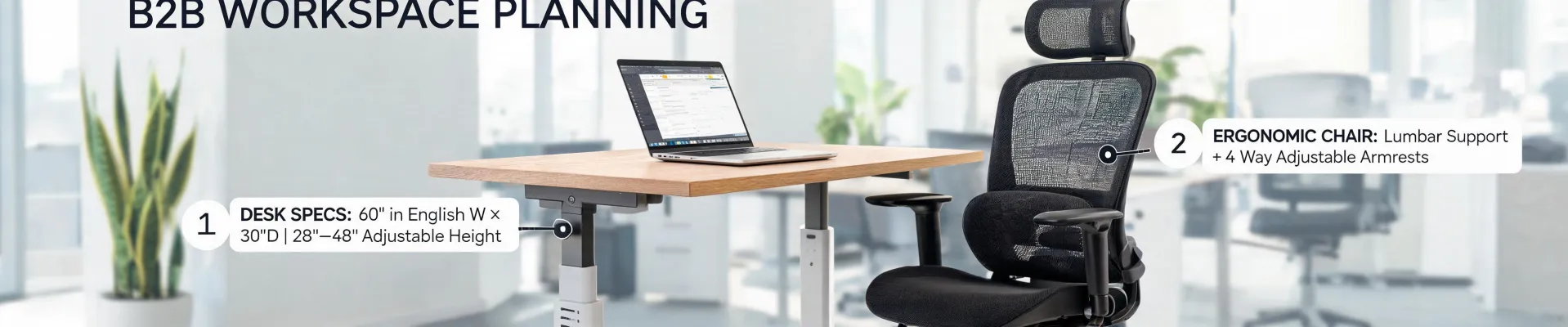
Surface Problem: The Desk That Wobbled
As quality and brand compliance manager at a commercial furniture company, I review every order before it reaches clients—roughly 200+ items a year. In 2024, I rejected about 14% of first deliveries for spec mismatches or visible inconsistencies.
The first batch of failing desks hit in Q1 2024. My instinct was: not again.
We'd bought 80 sit-stand desks for a newly renovated floor. Within three months, two departments reported motor noise. By month six, three desks had controllers that just stopped working.
The admin team went after the vendor. They sent a tech, took photos, and gave the standard response: 'environment-related.'
Two weeks of back-and-forth later, they reluctantly replaced the faulty components—but we ate the labor cost.
By then, I'd started wondering if we were asking the wrong question entirely.
What Most Companies Get Wrong
To be fair, 'find a new vendor' is a normal reaction. Ours did the same.
I got pulled into this process in 2022, when we started standardizing sit-stand desks across the company. Before that, employees picked their own chairs, desks, and monitor arms. In 2022 we decided to standardize: one brand, one procurement path.
On paper, that made sense. But the real problem revealed itself the following year.
We ran a side-by-side test. Same configuration, $630 from vendor A and $495 from vendor B. Five units each, same floor, four-week trial with two teams. The specs looked identical: electric height adjustment between 120–130 cm, dual motor, three-year warranty.
Four weeks in, the difference wasn't subjective anymore. Vendor A's desks barely moved even under full load. Vendor B's started wobbling above 115 cm—monitors visibly shook. Controllers were sluggish. Paint wear was already showing near one of the column joints.
We did a rough internal calculation: B's desks were adding roughly 25 minutes of maintenance time per employee per year, plus a 20% component failure rate within the first year, plus a replacement logistics cost we couldn't amortize.
I don't remember the exact numbers from that meeting. What I do remember is the feeling walking out: that $135 difference got eaten by twelve months of time and trust.
The Deeper Issue: Measuring the Wrong Thing Correctly
I think companies fall into two traps when buying office furniture.
The first trap: 'looks the same' gets read as 'is the same.'
It's tempting to think spec sheets work like a stair calculator—you enter inputs, you get a reliable output. But office furniture procurement isn't that kind of math.
Take dual-stage vs. triple-stage columns, cold-rolled steel thickness, weld treatment, and controller brand. Those four variables alone can make one desk far more stable than another—at the same listed size and nearly identical spec language.
After that test, I added a requirement: any desk bid has to include actual leg-structure data and lateral displacement at 120 cm. Not what they claim. What they can demonstrate.
It's like trying to figure out how to get permanent marker off a wall. You can follow generic advice, or you can match solvent to substrate. Same goal, totally different results—and the difference isn't effort. It's whether you actually know what you're working with.
The second trap: counting purchase price instead of the whole cost.
Budget processes, by default, look at the quote. But the real money sits in the lifecycle:
- Assembly: some desks take twice as long to install, or require a paid installer.
- Failure rates: in the same price tier, some products fail twice as often within three years.
- Accessory compatibility: monitor arms, cable trays, keyboard kits you didn't budget for.
- Residual value: good desks last 8–10 years, or move with you.
- Morale: hard to quantify, but real. If the desk wobbles, people don't use the standing feature—and the 'wellness' investment never happens.
Here's a useful mental frame. You can't apply savings bond calculator thinking to this problem. A savings bond calculator gives you one number from one deposit. Office furniture costs unfold over years, across categories, and in places that never show up on a vendor quote.
One data point from our own records: in 2024, roughly 65% of our furniture replacement budget went to items that looked cheaper upfront. So the low bid didn't save money—it just deferred the spend into messier categories.
What Those Hidden Costs Actually Look Like
If the procurement team only sees $495 vs. $630, the delta is $135. Add the hidden layers, and the picture changes.
From our 2024 records:
- Controller failure: $180 per desk for replacement motor and labor. Not on the quote.
- One batch mismatch—desktop and frame from different production runs—led to a six-week delay and $4,200 in expedited logistics.
- Monitor arms for six employees with unstable desks: roughly $90 each.
- One incident claim from a sudden height failure: about 12 hours of management time.
Rolling it up, lifecycle costs ran $260–$400 higher per desk than the sticker price. That's not a rounding error—it wipes out the procurement 'savings.'
I'm not saying buy the most expensive option. I've seen reasonably priced products perform well. The problem isn't price. It's that we weren't systematically evaluating TCO before buying, or reviewing it after.
What We Changed
We eventually moved to a simpler approach. Maybe it's useful if you're buying office furniture too:
- Define MUST specs, not NICE specs. For a desk: max lateral sway at 120 cm, motor response delay, controller warranty length, steel gauge.
- Require measured data, not marketing copy. Our test was basic: measure lateral displacement under load. It filters out candidates quickly.
- Run a TCO calculation, not a price comparison. Purchase price, assembly, expected repairs, replacement frequency, accessories, residual value. Once you build the template, the next round is faster.
- Create a feedback channel. Users see problems before they file tickets. We now run a short anonymous survey every six months.
I can't give you a universal formula—my experience is based on roughly 200 mid-range procurement projects in our own category. If you're sourcing at a different scale or in a different industry, your numbers will differ.
One Option Worth a Look: Fully Jarvis
You may have noticed I haven't pushed a specific brand—mostly because the whole point is to stop comparing brands on price alone.
That said, if you're already building a candidate list, Fully Jarvis is worth including. Not as a plug, but because a few specs line up with what the TCO framework actually rewards:
- Bamboo and hardwood top options that hold up over time
- Size and shape variety—including the L-shaped configuration that works well for larger workstations
- The Herman Miller relationship (Fully operates under the Herman Miller umbrella), which matters for long-term parts availability and warranty backing
In 2024, we tracked a sample of the Fully Jarvis standing desk line internally for six months. No controller or structural failures in that window, and user satisfaction came in measurably higher than the previous batch.
Small sample. Not a verdict. But if you're comparing quotes, put it in the pool and run the same TCO math. That's the point.
One Last Thing
Don't do what I did first—blame the vendor and move on. Vendors matter, absolutely. But if we're only reading quotes and ignoring use patterns and lifecycle costs, the root problem is on our side.
TCO thinking isn't just about saving money. It's about making sure people actually use what you buy. The real cost never lives on the first invoice.
