-
Fully Jarvis Standing Desk: Questions I Get Asked Before Every Order
-
Q: Is the Fully Jarvis standing desk worth the premium over a $300 Amazon option?
-
Q: Bamboo, hardwood, or laminate—which one actually holds up?
-
Q: Do we need L-shaped or is rectangular fine?
-
Q: Do employees actually use the standing function after the first month?
-
Q: What costs get left out of the proposal?
-
Q: Where's the best place to buy—direct or through a dealer?
-
Q: Is the Fully and Herman Miller connection actually meaningful?
-
Q: Is the Fully Jarvis standing desk worth the premium over a $300 Amazon option?
Fully Jarvis Standing Desk: Questions I Get Asked Before Every Order
I'm the office administrator for a 220-person company. I manage facilities and furniture orders—roughly $340K annually across 11 vendors. We've deployed about 180 Fully Jarvis desks over the past four years across two office locations, and I've fielded the same set of questions from ops, finance, and employees so many times that I figured I'd write them down.
Here's what people actually want to know:
- Is the Fully Jarvis worth the price compared to cheaper alternatives?
- Which material holds up best—bamboo, hardwood, or laminate?
- Rectangular or L-shaped?
- Do employees actually use the standing function after month one?
- What are the costs nobody puts in the proposal?
Q: Is the Fully Jarvis standing desk worth the premium over a $300 Amazon option?
Depends on how you define "worth." If you're buying one desk for one person and they might switch jobs in a year, the math is different than if you're fitting out a floor of 40 people.
My position is this: the cheapest option almost never turns out to be the cheapest. We tried a batch of budget electric desks in 2021—$280 each, looked fine in photos. Within 14 months, we'd replaced the control boxes on 6 of the 12 units. The motor on one died entirely. Between parts, labor, and the downtime complaints, we spent more than if we'd bought Jarvis frames from the start.
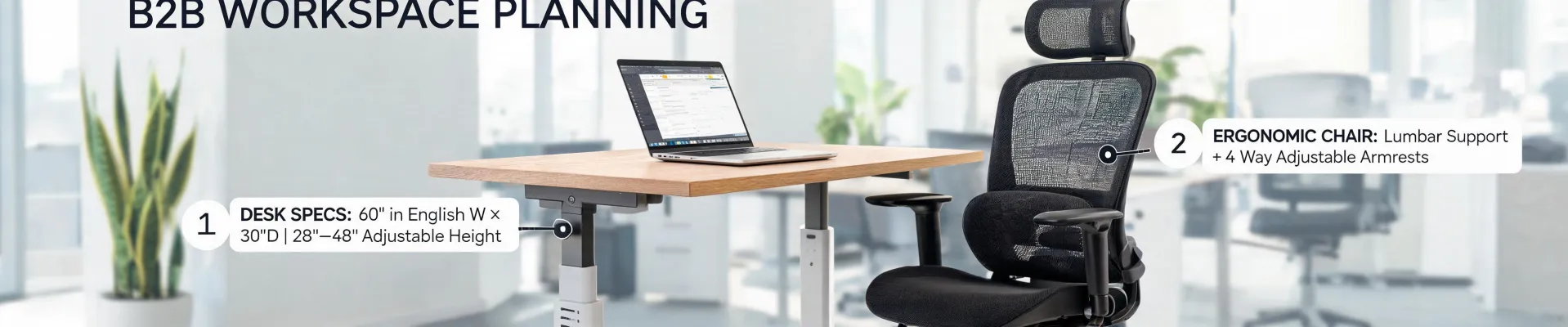
What I'll say for the Jarvis: the frame is solid, the warranty process (when we've needed it, twice out of 180 units) was straightforward, and I don't get emails about wobbling monitors. That last one matters more than it sounds. (Should mention: our heaviest users are engineers running dual 27-inch monitors plus a laptop dock.)
One caveat—my experience is based on commercial office deployments, not home offices. If you're buying for a single remote employee, your calculus might be different.
Q: Bamboo, hardwood, or laminate—which one actually holds up?
I get this one constantly, and honestly, I have mixed feelings. On one hand, bamboo is the eco-friendly pick and it looks great. On the other, I've watched a bamboo Jarvis top develop a visible cup ring from a coffee mug that sat there for maybe 40 minutes. That said, we've also had bamboo tops survive three years of daily use with nothing but a light oiling once a year.
Here's my rough breakdown after 4 years:
- Bamboo: Great aesthetics, decent durability, needs some care. Best for people who actually like the look and will treat it reasonably well.
- Hardwood: Heaviest, most durable, most expensive. If someone's going to abuse the desk (tools, hot mugs, eating lunch at it every day), go hardwood. We use these in our design team's area and they still look new.
- Laminate: Cheapest, most forgiving, least interesting to look at. Actually a solid choice for conference rooms or hot-desk setups where nobody owns the surface.
From an admin standpoint, laminate wins on maintenance cost. From an employee happiness standpoint, bamboo wins 9 times out of 10. Finance prefers laminate.
Q: Do we need L-shaped or is rectangular fine?
I've only worked with standard rectangular and L-shaped Jarvis configs, so I can't speak to the corner or curved variants. But between those two: L-shaped is worth it if the person runs multiple monitors or does a lot of side-by-side reference work. We've got L-shapes in our finance team and rectangular everywhere else.
The catch with L-shaped: they eat more floor space and the height adjustment has to be more carefully planned. One of our L-shaped desks sits near a window and when raised, the corner blocks a colleague's view. Nobody told me that would be an issue—I found out via a Slack message that started with "hey, small thing."
Q: Do employees actually use the standing function after the first month?
The most frustrating part of deploying standing desks: people who never stand. You'd think anyone who asked for one would use it, but that's not reality. When we surveyed our team 8 months post-install, about 40% used the standing function daily, 35% used it a few times a week, and 25% basically treated it as a normal desk.
That 25% is what finance notices. And they're not wrong to notice—we're paying a premium for a feature that a quarter of users ignore.
What helped: we didn't "encourage" standing. We just made it available and didn't make a big deal of it. The people who wanted it use it. The people who didn't don't feel pressured. Honestly, that's the right balance. Forced wellness initiatives backfire.
Q: What costs get left out of the proposal?
Always the same list:
- Assembly labor. If you're not doing it in-house, budget $75–120 per desk. We do ours with a facilities team of 2 and it takes about 25 minutes per desk once you've done a few.
- Cable management accessories. Nobody includes these. Every single desk needs them. Budget $40–80 per desk.
- Monitor arms. If you're raising and lowering the desk, a monitor that was fine at one height might not be at another. We've standardized on gas-spring arms for standing desk users—adds about $100 per workstation.
- Floor protection. The legs can scuff softer flooring when moved. Felt pads under the feet, $5 per desk, saves a $4,000 flooring repair.
That $200 "savings" on a cheaper desk option can quietly turn into $1,400 in hidden extras if you don't plan for them.
Q: Where's the best place to buy—direct or through a dealer?
We've done both. Direct from Fully for the initial deployment, through a commercial furniture dealer for the second wave when we needed to coordinate with a bigger office refresh.
Direct pros: cleaner pricing, faster shipping on standard configs. Direct cons: you're handling assembly and disposal yourself.
Dealer pros: they handle site coordination, assembly, packaging removal, and can bundle with other furniture. Dealer cons: 10–20% markup on the desk itself, and lead times are typically longer.
For 5 desks: go direct. For 50+: get dealer quotes. Watch for dealer pricing on Jarvis—some are authorized, some aren't, and unauthorized sellers can complicate warranty claims.
Q: Is the Fully and Herman Miller connection actually meaningful?
Yes, and here's why it matters for procurement: it means the warranty and service history is backed by a large company. When we had a frame issue in 2023, the replacement part arrived in 4 days. That kind of response isn't guaranteed with smaller direct-to-consumer brands.
It also means the product line has some stability. We can order the same frame config now that we ordered in 2022, which is not something I can say about every brand we've bought from.
That said, "backed by Herman Miller" isn't the same as "is a Herman Miller product." If you're expecting Herman Miller-level fit and finish on every detail, you'll notice the difference on things like cable trays and control panels. It's a good desk. It's not a $3,000 executive desk.
Final note: prices and lead times change. I've referenced what we paid historically, but verify current pricing before you build a budget. My experience is based on about 180 units deployed across two commercial offices—if you're doing home office or hot-desk deployments at scale, some of this won't map cleanly.
