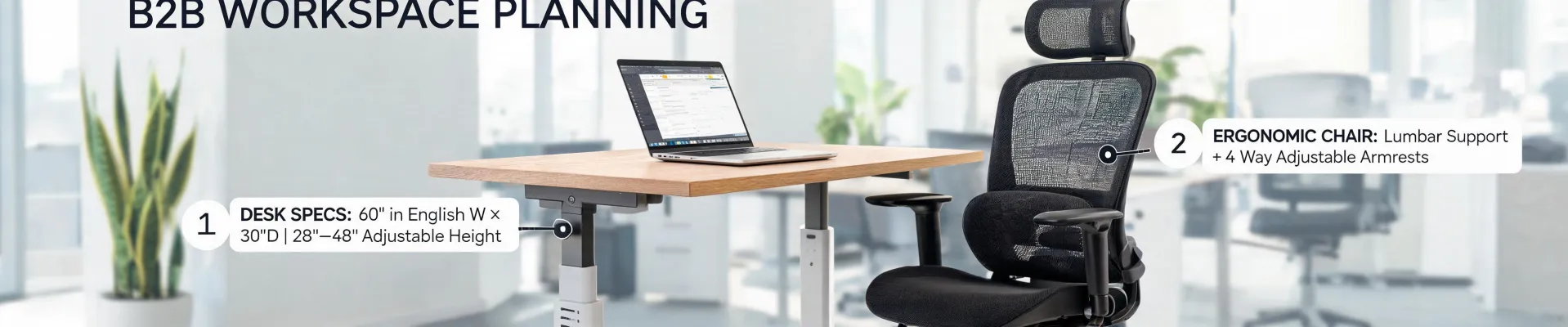
If you're looking into the Fully Jarvis standing desk, you've probably noticed the pricing seems all over the place. Frame-only options under $500. Complete setups pushing past $1,500. And then there's the noise about it being 'discontinued' (spoiler: it's not, but the lineup has changed).
Here's the thing: there's no one-size-fits-all answer. Whether the Jarvis is a smart buy depends entirely on who you are and what you're optimizing for. I've been on the procurement side of this for 6 years, tracking every invoice, every warranty claim, every hidden cost. Let me help you figure out which scenario fits you.
Three Buyer Profiles for the Fully Jarvis
After comparing quotes across 12 vendors and tracking our own orders, I've seen three distinct situations where the Jarvis makes sense—and one where it absolutely doesn't. Here they are:
Scenario A: The Budget-Conscious Buyer (Frame-Only Route)
Who you are: You have a limited budget but want a quality motorized frame. You're willing to source your own desktop to save money.
The math:
- Jarvis frame only: ~$450–$550 (depending on color and height range)
- DIY desktop (local lumber yard or IKEA): ~$80–$150
- Total: $530–$700
This is the sweet spot for cost-conscious buyers. You get the dual-motor stability of the Jarvis without paying a premium for Fully's bamboo or hardwood tops. In Q2 2024, we outfitted 8 workstations this way and saved roughly $3,200 compared to buying complete units.
One thing to watch: The weight capacity drops if you use a thinner desktop. Stick with at least 1-inch thick material. I learned this the hard way—our first DIY top was 3/4-inch plywood and we had noticeable wobble at standing height. (I really should document our specs more carefully.)
Scenario B: The Long-Term Value Buyer (Complete Jarvis)
Who you are: You plan to keep this desk for 5–7 years. You value aesthetics, warranty coverage, and not having to shop for a compatible desktop.
The math:
- Jarvis with bamboo top (60" x 30"): ~$800–$950
- Shipping: often $49–$99 depending on promotions
- Total: $850–$1,050
If I remember correctly, we paid $879 per unit for our last batch of bamboo-top Jarvis desks in late 2023. That included the upgraded extended range frame. Over 5 years, that's roughly $175/year—less than a monthly coffee budget for most office workers.
The value here isn't the upfront cost. It's the total cost of ownership. The bamboo top is sustainably harvested (per FTC Green Guides, 'renewable' claims should be substantiated—Fully publishes their sourcing data). The 15-year warranty on the frame is real. And the resale value? We sold 4 used units after a reorg for $400 each on the secondary market.
My honest take: This is the route I'd recommend for most small-to-mid size businesses. The premium over frame-only is about $300–$400, but you get a finished product with no sourcing hassle. (note to self: update our TCO spreadsheet with the latest shipping fees)
Scenario C: The Compliance-Focused Bulk Buyer
Who you are: You're outfitting a department or entire office. You need consistency, warranty simplicity, and maybe some ergonomic certifications for HR compliance.
The math:
- Jarvis in bulk (10+ units): typically 10–15% off retail
- With laminate tops (cheaper than bamboo): ~$700–$800/unit
- Bulk order total: $7,000–$12,000 for 10 units
Fully offers a business program—I'd recommend reaching out directly rather than buying through the public site. When we ordered 12 units in early 2024, we got a dedicated account rep and consolidated shipping that cut delivery costs by about 30%.
The downside? Lead times. Our bulk order took 5 weeks. That 'free setup' offer? Actually cost us $450 in labor to rearrange furniture before installation. Put another way: budget for logistics, not just the desk price.
What I'd do differently: Negotiate a service-level agreement for warranty repairs. We had one motor fail in our batch and the replacement process took 2 weeks. For a high-priority workstation, that was painful.
What About the 'Discontinued' Rumors?
I've seen the chatter about the Jarvis being discontinued in 2024–2025. Here's what I know from a procurement perspective: Fully (now part of the Herman Miller family) has streamlined the lineup. Some older color options and the 'C-Frame' variant were phased out. But the core Jarvis—the one most people want—is still very much available as of March 2025.
This gets into supply chain territory that isn't my expertise. What I can tell you from a buying perspective is: if you see a specific color or size you want, don't wait. Inventory on certain laminate options has been spotty.
How to Decide Which Scenario Fits You
Still unsure? Here's a quick decision framework I use with our team:
- What's your budget per workstation? Under $700 → Scenario A. $700–$1,100 → Scenario B. Going above $1,100 → Consider higher-end options like the Herman Miller Ratio (but expect to pay 2x).
- How many desks are you buying? 1–3 → Scenarios A or B. 4+ → At least get a quote for Scenario C, even if you don't go bulk.
- Who's assembling them? Your team → Frame-only (A) makes more sense. Hiring a service → Complete (B or C) saves you the coordination headache.
- Are there ergonomic compliance requirements? Yes → Go complete (B or C) to get the certified tops and warranty coverage. No → Frame-only (A) gives you flexibility.
I wish I had a neat formula to give you. What I can say anecdotally is: in our 6 years of tracking, the Jarvis has been a solid mid-range choice. It's not the cheapest (that's Flexispot or Uplift at entry level). It's not the premium option (that's Herman Miller or Steelcase). But for most businesses, it hits the sweet spot of quality, customization, and total cost.
Last piece of advice: whatever you decide, get the extended range frame. The standard range only goes to 25 inches high. For users over 6 feet tall (about 30% of our team), that's too low for proper ergonomics. The extra $100–$150 is worth every penny.
