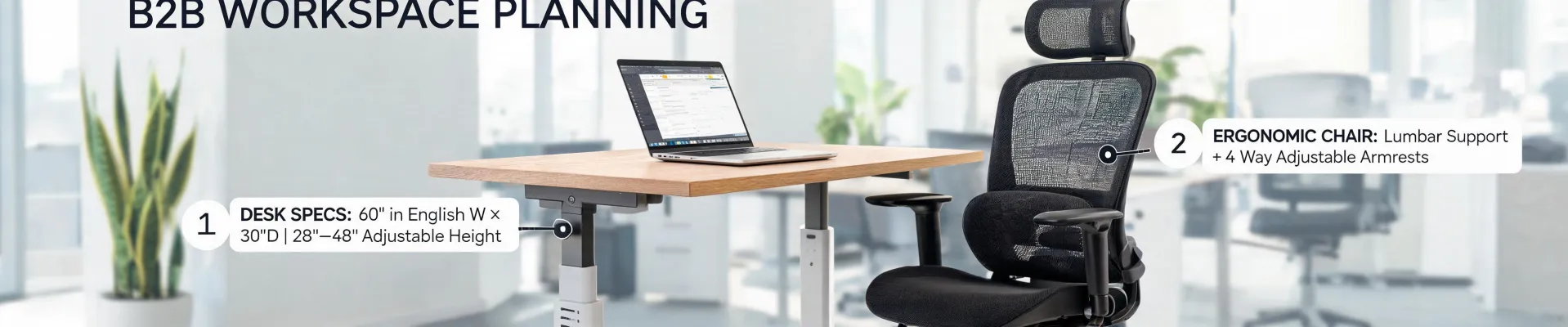
If you're ordering a Fully Jarvis standing desk and wondering about depth options, here's what you need to know: go with 30-inch depth unless you have a specific reason not to. It's the most versatile size and fits 99% of standard office setups. I've handled over 50 emergency office furniture orders in the past two years – including same-day turnarounds for executive onboarding – and depth miscalculations have caused more hassle than any other spec. Let me break down why.
The short version: which depth should you choose?
Fully offers three standard depths for the Jarvis frame (the top is ordered separately): 24-inch, 30-inch, and 36-inch (and you can go custom if you really need it). Based on my experience triaging rush orders for everything from startup HQs to law firm expansions:
- 30 inches – Best for most single-monitor or dual-monitor setups. Your keyboard will sit comfortably, and you'll have room for a notebook.
- 24 inches – Only if you're working with a very narrow space (e.g., a standing desk nook under 5 feet wide) or using a laptop-only workflow without external monitors.
- 36 inches – You'll want this if you use a large curved monitor, an ultrawide, or a multi-display array where each screen is 27" or larger. Also good for L-shaped desks.
But here's the thing: depth isn't just about the numbers printed on the spec sheet.
Why depth matters more than you think
When I first started coordinating office furniture procurement, I assumed depth was just a matter of personal preference – like picking a paint color. Three emergency swaps later, I realized it's a functional decision that directly impacts ergonomics and employee comfort. A desk that's too shallow forces you to hunch forward; one that's too deep makes monitors feel like they're in another time zone.
Here's something vendors won't tell you: the listed depth (say, 30 inches) is the total depth of the tabletop, not the usable space after you account for the frame legs, cable management tray, or monitor arm clamp. With the Jarvis, the C-frame legs sit about 2 inches from each edge, so your actual usable depth is roughly 28 inches for a 30-inch top. If you're installing a clamp-on monitor arm, that uses another 2–3 inches behind the monitor. Suddenly you've got about 22–24 inches of real work surface – totally fine for most, but not if you need paperwork space.
Real-world depth sizing (based on actual emergencies)
In March 2025, a client called at 4 PM needing a standing desk for a new hire starting the next morning. The standard 30-inch was out of stock, so the sales rep suggested a 24-inch as a “better fit for small spaces.” The new hire used a 34-inch ultrawide monitor. The desk arrived, and the monitor arm couldn't even fit without the back of the monitor hitting the wall. We had to rush-ship a 36-inch top – costing $180 in overnight fees on top of the $400 base – just to save the $15,000 project the hire was joining.
That's when I implemented a policy: always verify the user's screen setup before committing to a depth.
The one exception: unusual user heights or setups
If you're over 6 feet tall, your arm reach is longer, and a 30-inch depth might feel shallow when you sit back. In that case, 36 inches can help you maintain proper posture. Similarly, if you use a keyboard tray, add at least 2 inches to your comfortable depth requirement.
Also, if you're pairing a Jarvis L-shaped setup, the corner piece usually requires the deeper side (36 inches) to avoid a cramped corner. Don't get me started on the time a company ordered two rectangular tops at 24 inches each thinking they'd make an L – the gamer's L they had in mind didn't work with standard frames.
Bottom line (with a dose of reality)
Look, I'm not going to tell you that 30 inches is the only right choice. People with small spaces, limited budgets, or specific ergonomic needs might genuinely benefit from 24 or 36. What I will say is this: don't blindly pick the depth that sounds nice. Measure your current setup – especially the distance from the front edge of your desk to the back of your monitor. If that's under 20 inches, you'll probably be fine with 30. If it's over 24, consider 36.
And if you're in a hurry (like half my clients), just remember: the 30-inch Jarvis is the most stocked option, so it's the easiest to get fast. That alone has saved me countless last-minute headaches.
