I'm a procurement manager at a 40-person design firm. I've managed our office furniture budget (roughly $60,000 a year) for the past six years, negotiated with more than 20 vendors, and documented every order in our cost tracking system. That last part matters, because this isn't going to be another generic Fully Jarvis standing desk review 2025 that just lists specs. I want to talk about the numbers that actually show up on a spreadsheet.
Here's the thing: in 2025, you don't need to justify whether standing desks are a real category. The industry has evolved. What was best practice in 2020—paying a premium for any electric desk—feels outdated now. You can buy a dual-motor standing desk for the price of a nice ergonomic office chair. But the fundamentals haven't changed: stability, warranty, and support still separate a good desk from a frustrating one.
Why I'm Comparing the Fully Jarvis to a Budget Desk
Most reviews compare the Jarvis to other premium desks. That's not the purchase decision most companies make. The real A vs B in 2025 is between a Fully Jarvis and a generic budget electric desk that shows up in your ads for $349. I know because I've evaluated both for our own offices.
I've also built a TCO spreadsheet that covers more than the purchase price. It includes shipping, setup time, expected lifespan, warranty claims, and downtime. When I compare the Fully Jarvis to a budget desk, that's the framework.
Before I go deeper: I'm not saying budget desks are always bad. Some are fine for low-use areas. I'm saying the difference isn't the sticker price. It's what happens after year one.
Dimension 1: Total Cost of Ownership
The budget desk wins on day one. Any procurement person will tell you that. But a 3-year total cost of ownership tells a messier story.
Early on, every spreadsheet told me to buy the cheaper desks. My gut said the Jarvis would be a better long-term home. We ended up with a mix—Jarvis for the core team, budget desks for one project room. The data made the decision for me within 18 months. I've trusted the TCO model ever since.
Let's use a realistic example. A generic dual-motor frame with a laminate top might cost $400 to $500 delivered. A Fully Jarvis with a similar configuration is likely a few hundred dollars more. That's a real difference, especially if you're buying ten desks at once.
But the budget desk's cost often isn't finished when it arrives. Here's something vendors won't tell you: the cheap controller and switches on lower-tier desks are the first things to fail. I've tracked two failures in our own office within 18 months. The replacement controller cost about $120, plus an hour of my IT guy's time, plus a week of 'desk is stuck at sitting height' frustration. The actual cost was closer to $200 per failure. Over six years, that changes the math.
The Jarvis, on the other hand, came with a heavier frame, better cable management, and a control box with a longer track record. Not perfect, but workable. And the price difference shrank every time a budget controller died.
My conclusion: if you plan to keep the desks for more than two years, the Jarvis isn't the premium choice. It's the boring, predictable choice. The budget desk only makes sense if you expect low usage or a short lease.
One more buying note: if your office has brand colors, don't assume the powder coat on a frame will match your logo. The Pantone Color Matching System is a standard for printed materials, with an accepted tolerance of Delta E < 2 for brand-critical colors. Metal finishes are a different process. Ask for a physical sample before you order twenty matching desks. Reference: Pantone Color Matching System guidelines.
Dimension 2: The Fully Jarvis Standing Desk Warranty
This is the part most reviews gloss over, and it's probably the most important thing I look at. The Fully Jarvis standing desk warranty is genuinely different from the budget category.
At my last check of the Fully warranty page, the Jarvis frame is covered for 15 years, and the motors, control box, and desktop are covered for 5 years. That's in writing. For a budget desk, you'll often see a 1 to 3-year limited warranty. Some don't even cover shipping both ways.
What most people don't realize is that warranty length only matters if the claim process actually works. With a budget desk, you might get a replacement part after an email back-and-forth. But you're the one crawling under the desk to swap out a motor. I've done it. It's not fun.
With the Jarvis, the process isn't always glamorous, but it has been straightforward in our experience. They asked for a video of the issue, confirmed the part, and shipped it. No endless 'have you tried turning it off and on again' script.
Real talk: no warranty makes a broken desk less annoying. But a warranty from a company that's actually going to exist in ten years matters. Fully is part of the Herman Miller family now, and that institutional backing gives me more confidence than a random marketplace seller.
Still, the surprise here is that the budget desk's warranty isn't automatically useless. If you buy from a reputable dealer that stocks replacement parts, a 2-year warranty on a low-use desk can be enough. You just have to read the fine print and know who's behind it.
Dimension 3: Ergonomics Is More Than the Desk
Here's where a lot of companies get it wrong. They buy standing desks and call it an ergonomics program. Then they pair the desk with a folding chair from 2009 and wonder why everyone still complains.
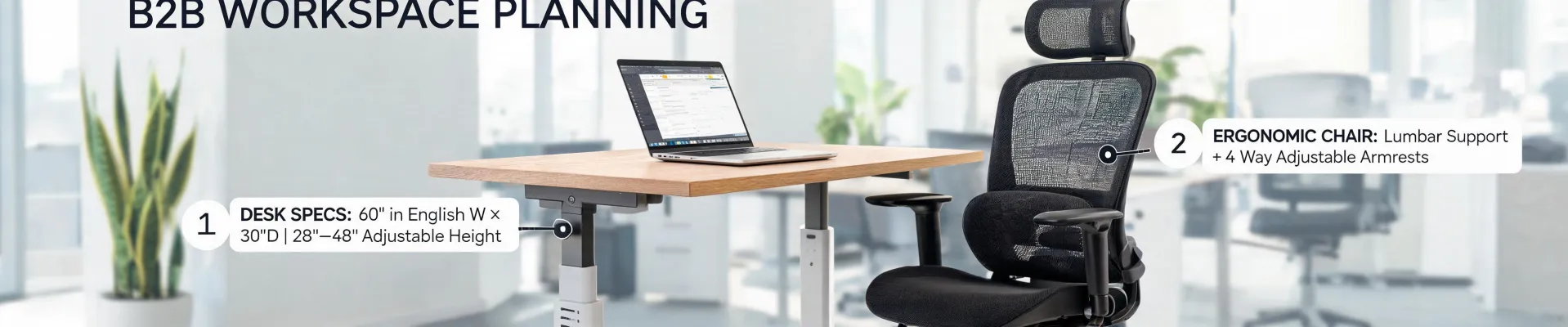
A Fully Jarvis without a decent ergonomic office chair is half a solution. I budget for both at the same time. The chair supports your posture when you sit; the desk gives your spine a break when you stand. They're a team.
I've also learned to measure the behavior change, not just the equipment. Earlier this year, we ran a small experiment for 12 people. After 60 days with standing desks, their step counters showed an extra 3,100 steps per person on an average day. Plug that into a steps to miles calculator, and that's about 1.4 miles per person. For the whole team, it added up to nearly 17 miles a day. Not a clinical study, but enough to make the CFO stop arguing about the budget.
The comparison dimension here isn't Jarvis vs budget—it's 'desk plus chair plus habits' vs 'desk alone.' A cheap standing desk with a good chair and a real wellness plan is more effective than an expensive desk with nothing else. That might sound obvious, but I've seen it inverted more times than I can count.
Dimension 4: Support When Stuff Breaks
Until you've dealt with a broken desk controller, you don't know the meaning of 'office downtime.' The desk freezes at standing height. The monitor now floats at eye level. Your employee is working like a bartender behind a counter for a week.
With a budget desk, the support experience varies wildly. Some vendors send a replacement part after one email. Others make you provide proof of purchase, serial numbers, and a video, then still take a week to respond. I've googled 'how to fix printer problems' out of pure frustration during one of these sagas—because the error code on a cheap controller looked exactly like a printer error, and at least a printer gives you error codes.
The Jarvis support has been, in my experience, faster and less combative. They also have a more generous parts policy because of the warranty structure. When we had a switch issue on one frame, they replaced the keypad without asking us to ship the whole desk back. That's what good support looks like in the real world.
The surprising conclusion: the 'premium' brand isn't always premium on support. But in this case, the Fully support structure matched the warranty claims. That's rare, and it's worth paying for if you have anyone who's not comfortable with a screwdriver.
What I'd Actually Choose
Here's my practical advice, based on the scenarios I've seen in our own office and with other teams:
- Buy the Fully Jarvis if the desks will be used daily by people who care about their workstation. You'll get a better long-term total cost of ownership, a real warranty, and a smoother support experience. The price difference is worth it over three to five years.
- Consider a budget desk if you need a few desks for a conference room, a break room, or a place where people will stand for 10 minutes at a time. Low usage means lower risk, and a cheaper desk is probably fine.
- Don't buy anything until you've set aside money for an ergonomic office chair. The desk is the flashy purchase; the chair is the one your employees feel all day.
- If your leadership team needs proof that this stuff matters, run a small pilot and use a steps to miles calculator to show the movement difference. Data beats opinions in procurement meetings.
Look, I'm not here to tell you that the Fully Jarvis is the only desk worth buying. That would be lazy. But after six years of spreadsheets, failed controllers, and more vendor calls than I want to count, it's the desk I've stopped worrying about. And for me, that's the highest compliment a cost controller can give.
