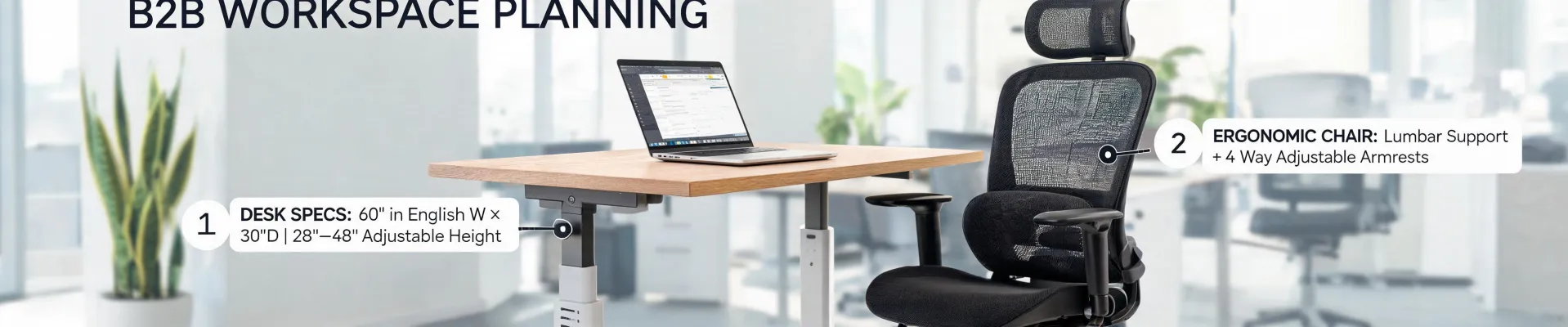
For context, I'm an office administrator at a 60-person company. I manage all facilities ordering—roughly $180,000 a year across maybe 15 vendors (could be 18; I'd have to check the system). I report to both operations and finance. And in 2021, I made the classic rookie mistake: I chose office desks based on the lowest unit price.
The quote for the so-called 'value' sit-stand desk was $349. The better-known model was $649. I went with the $349 because, hey, same function, adjustable height, looks fine. I bought 18 of them and celebrated saving $5,400.
(Should mention: the $349 price didn't include the hand controller. I had to order those separately. That should have been a clue.)
The problem wasn't the desk. It was everything around the desk.
Day one, the desks looked good. Day 40, the first controller died. That was replaced under warranty, but the process took three weeks and four emails. Day 90, a desktop arrived warped. The vendor sent a replacement but asked me to dispose of the old one. I became the office furniture disposal department.
By month 14, one motor failed. The warranty covered the part, but not the labor. I had to find someone who could remove the panel, unscrew the motor bracket, ship it back, and reinstall the new one. That cost us $220, plus a half-day of lost work for the employee whose desk was in pieces.
Here's where the math breaks down. My unit-price saving was $5,400. After freight, controllers, disposal, and repair labor, the real saving was probably less than half that. The missing few thousand dollars didn't show up on any invoice. It showed up as my time, the vendor's return process, and one employee's ruined afternoon.
The deeper problem: I was treating a purchase like an isolated transaction
I wasn't mature enough in my role then to say this, but now I know: the real problem was not the vendor. It was the decision-making framework. I was asking 'which desk costs less?' instead of 'what does this desk cost over three years?'
Price is what you pay at checkout. Total cost is what you pay after freight, setup, accessories, repairs, downtime, and disposal.
Total cost of ownership isn't a buzzword. It's a short list:
- base price
- freight and delivery
- setup or installation
- necessary accessories
- maintenance and warranty support
- employee downtime when something fails
- end-of-life disposal or resale
The $349 desk was really $349 plus a share of the freight bill, plus a $45 controller, plus my time. The $649 desk would have included the controller and freight, and I wouldn't have had to assemble it myself. I can't say with certainty that the expensive desk would never have failed. But I can say I never gave it a fair chance.
The chair problem is the same problem
After the desk mess, I had to order office chairs. I asked the team what they wanted. They said 'good chairs.' I heard 'the $89 chairs are fine.'
They were not fine.
Within six months, one employee bought a lumbar cushion with their own money. Another asked if we could order the chair from their old office. One person quietly started taking more breaks because their lower back was stiff. I can't prove the chair caused any of it. But the team's productivity cost was a lot harder to fix than the chair cost.
This is why I hate 'cheap chair' lists. They focus on height adjustment and a five-year warranty, but completely ignore the fit.
If you're wondering how to pick the best office chair, start here: seat height range, lumbar support, seat depth, armrest adjustment, and a return policy that gives you at least 30 days. Those five things matter more than color or brand. If you have employees over 6 feet tall or under 5 foot 4, make them test the chair before you buy a full set.
Printable graph paper is secretly a procurement tool
One of the cheapest tools in my office is also the most underrated: printable graph paper. I print desk footprints to scale on A4 paper, tape the sheets together, and leave the paper outline on the floor overnight.
It sounds embarrassing, but it works. If a chair can't roll back without hitting the wall because the desk printout is too wide, you know before you order. If a standing desk's height range can't work with a monitor arm because the desk is too deep, you see it in the paper mockup, not after the freight truck arrives.
A4 paper is a few cents per sheet. Printable graph paper is free if you know where to look. The cost of one wrong desk order is hundreds or thousands. That's TCO thinking applied to paper.
What I'd do now
I don't buy any office furniture without a three-year total cost estimate. That's not a fancy spreadsheet—it's a sticky note with four columns: purchase price, delivery, setup, and 'things I'll probably need to fix or replace.'
When I started looking at a Fully Jarvis standing desk for our next purchase, I didn't search for 'cheapest standing desk.' I searched for 'Fully Jarvis standing desk buy' because I wanted to compare the complete package, not just the base. The options matter too: bamboo top, hard laminate, rectangular or L-shape, depth, cable management. Those aren't upsells; they're part of the total cost because they either fit your team or create new problems.
The frame-only option is tempting if you already have a desktop. But if you don't have a compatible top, the frame-only route can end up costing more after hardware, drilling, and finishing—I know from a different project, not this one.
I'm also not going to pretend expense reports are fun. But if a vendor can't provide a clean invoice, don't order. That rule came from a $2,400 invoice-related disaster in 2022, not from a textbook.
No grand conclusion
The point isn't that you should never buy a cheaper desk. It's that 'cheaper' has to include all the costs after the checkout page.
Some of our best purchases have been budget items. Some of our worst have been budget items too. The difference wasn't luck. It was whether I looked at the price or the total cost.
So before you buy any desk, chair, or even a box of paper, ask the question that sounds stupid at first: what does this actually cost after a year? The extra ten minutes of math might be the cheapest part of the whole project.
