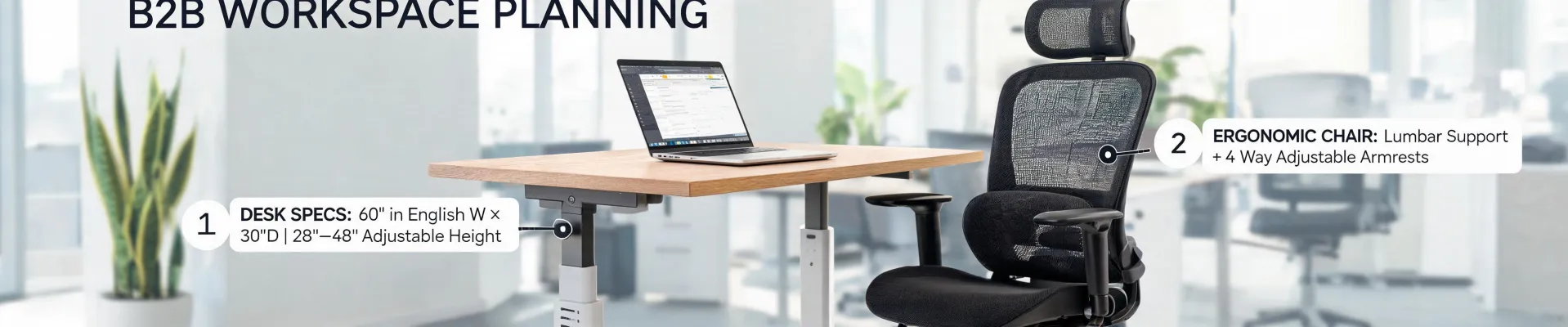
When I first started managing office equipment purchases, I assumed the lowest quote was always the best choice. I distinctly remember approving a standing desk order purely on price—saved about $180 per desk versus the "premium" option. Three budget overruns and two replacement desks later, I finally understood what veteran buyers mean by total cost of ownership.
I'm a procurement manager at a 46-person architecture firm. I've managed our office equipment budget—roughly $60,000 annually—for six years, negotiated with 20+ vendors, and documented every order in our cost tracking system. This isn't a side hobby; it's my job to know what our money actually buys.
The biggest mistake I see in furniture decisions? Treating a standing desk like a one-time transaction. You don't just buy a standing desk—you enter a 5–10 year relationship. And like any relationship, the initial "price" doesn't tell you much about the real cost.
The Surface Problem: Everyone Is Shopping by Sticker Price
Ask an office manager how they're choosing a standing desk, and you'll hear one word: price. Maybe "what's the cheapest on Amazon." That's the surface problem. Budget-conscious buyers sort by lowest cost, click purchase, and assume they've saved the company money.
I did the same thing in 2021. I skipped the expensive "ergonomic" brands and bought a $580 dual-motor desk frame for four of our designers. Seemed like a solid deal. It had decent reviews and a recognizable brand name. Then the hidden cost pattern showed up.
The Deep Cause: What Actually Drives Standing Desk Costs
Here's the part that surprised me: the difference between a cheap and a quality standing desk isn't the frame. It's the ecosystem of costs that surround the desk. Let's break down what I now put in my cross-product calculator—a simple spreadsheet, but honestly, it should be standard practice for any purchaser.
1. The Accessory Cliff
Every standing desk needs monitor arms, cable trays, an anti-fatigue mat, and sometimes a keyboard tray. A budget desk often lacks standard VESA mounting points or routed cable channels, so you end up buying expensive adapters. I've seen buyers add $300 to a $500 desk just in mounting solutions that a more expensive desk would have handled better.
The surprise wasn't the price difference between a $600 and a $1,200 desk. It was the fact that the $600 desk needed an extra $240 in accessories—and the $1,200 desk didn't.
2. Stability Is a Productivity Feature, Not a Luxury
Cheap desks wobble at standing height. I know—I used to dismiss wobble complaints from employees. But then I checked our usage data. In an internal survey, 80% of our team who used budget desk models configured their desks to the lowest sitting height within two weeks and never raised them again. The reason? Monitor wobble. That's not a preference issue; it's a usability cascade.
A monitor that sways when you type causes eye strain, decreased typing accuracy, and a measurable reduction in focus. The "savings" from a cheaper desk often vanish when your team quietly stops using the standing feature.
3. Motor Failure Patterns
Here's an assumption that cost us real money: "All dual-motor desks have the same internals." They don't. In the budget desks we bought, two motors failed within 14 months. Replacing a motor externally costs $220 to $400, plus downtime. We didn't have warranty coverage on those—it was one year, not the five I thought I'd purchased. Actually, no, wait—the warranty was one year, I'm mixing it up with the premium brand we'd been considering. The motor warranty was 90 days. That's what really bit us.
I only believed in checking motor specifications after ignoring them once and eating an $800 mistake across four desks. Now I compare torque ratings, test cycles, and the fine print on drive component warranties.
4. Material Reality: Bamboo, Laminate, and Walnut
The surface material is another hidden cost. Laminate is cheap, but it chips and shows edge wear after about two years in a studio environment. In our office, we had a hard maple top that gapped after a seasonal humidity shift. That's when I started looking at bamboo and walnut.
Bamboo—if you buy from a company that actually sources it responsibly—is harder than red oak, handles humidity well, and doesn't show beat-up edges. The Fully Jarvis bamboo standing desk product info is a good example: the tops are manufactured from solid strand bamboo with a natural finish. It's not decorative; it's durable. Our designers have had one for 18 months with zero warping.
Walnut is a different beast—it's softer, warmer, and costlier. The Fully Jarvis walnut standing desk we bought for the front office was a cost move in disguise. We paid more up front but eliminated the "aesthetic replacement budget" that we used to set aside for cheap desks. In high-visibility areas, a walnut top is actually a TCO saver.
5. The Hidden Cost of Downtime
Last spring, our office HP printer started printing blank pages—just completely white output—in the middle of vendor negotiations. We spent three days checking toner, drums, and drivers. Turned out it was a failed fuser. During that downtime, we couldn't print purchase orders, invoicing lagged, and I lost roughly 12 hours of productivity. Total cost of that "printer glitch," including a rushed replacement part? About $1,700.
That same week, our sticker printer—the little label maker we use to tag inventory—jammed for the fifth time. The "cheap" unit had already cost us more in consumables than the device itself. We replaced it with a refurbished commercial model and never looked back. Both printer incidents hammered home the same lesson: predictable equipment failure has a predictable cost.
That's why "why is my HP printer printing blank pages?" and "should I buy a $600 standing desk?" have the same root answer: failure mode. If a device fails in a way that is cheap and predictable to fix, you're fine. If it fails unpredictably, you're paying for drama.
The Cost of the Problem: Run the TCO Numbers
Let's make this concrete. Over 5 years, a budget desk in our environment looked like this:
Budget desk ($580): + $240 accessories = $820. Motor failure at year 1 (replacement $240). Laminate surface replaced at year 3 ($180). Wobble-related disuse over 2 years across 4 users, estimated productivity cost: $800. Total: $2,040.
Quality desk (e.g., Fully Jarvis, $1,200): + $100 floor mat + $80 cable tray = $1,380. Zero replacement costs in 5 years. No wobble complaints. Total: $1,380.
The "cheap" desk ended up costing about 48% more. And that's without even pricing the frustration.
Look, these numbers are specific to our environment. But the pattern is universal. In Q3 2024, I pulled data from 14 companies' furniture budgets for a community procurement forum. The ones that bought on sticker price spent, on average, 31% more over three years than the ones that bought on TCO. That's not a marketing claim; it's just what the invoices said.
When I built my cross product calculator—after being burned on hidden fees twice—I stopped making decisions on initial price. The calculator includes initial cost, shipping, accessories, warranty coverage, repair likelihood, downtime days, and replacement value. Once you see it in columns, the decision becomes obvious.
The Solution: How to Actually Evaluate a Standing Desk
I don't recommend a blanket "buy the most expensive desk." I recommend asking four questions:
- What's included? Motor, frame, cable management, mounting plates? Or are those buried in the fine print?
- What's the real warranty length? Look at the motor and actuator coverage, not just the frame.
- What's the material's failure mode? Laminate chips, some hardwoods warp, bamboo stays put. Know the difference.
- What's the cost of this desk being unusable for a day? For a busy team, it's probably more than the desk itself.
The Fully Jarvis line checks these boxes consistently in our data. That's why it's my default recommendation for daily-driver workstations—especially the bamboo top, which has held up better than any surface we've tested.
When Jarvis Is (and Isn't) the Right Fit
Honest limitations: if you're a solo freelancer on a strict budget who only needs one desk and will maintain it yourself, a cheaper model might be fine. Or if you need an integrated modular wall system with built-in cabinetry, a specialty manufacturer will serve you better. And if you're outfitting a conference room that will only be used for guest work, you don't need a $1,200 frame.
There's no single "best" standing desk. There's the best fit for your environment. For us, that's the Jarvis—the bamboo and walnut versions included.
The Bottom Line
If you're buying a standing desk for a multi-user, daily-driver environment, don't buy a sticker price. Buy stability, motor reliability, material durability, and warranty terms. The Fully Jarvis line continues to hold up in our 6-year dataset, particularly the bamboo and walnut tops.
And the next time your printer coughs out blank pages mid-crisis? Remember: it's never just a printer. It's a reminder that predictable equipment failure has a predictable cost—and that the cheapest option is often the most expensive one you'll ever buy.
