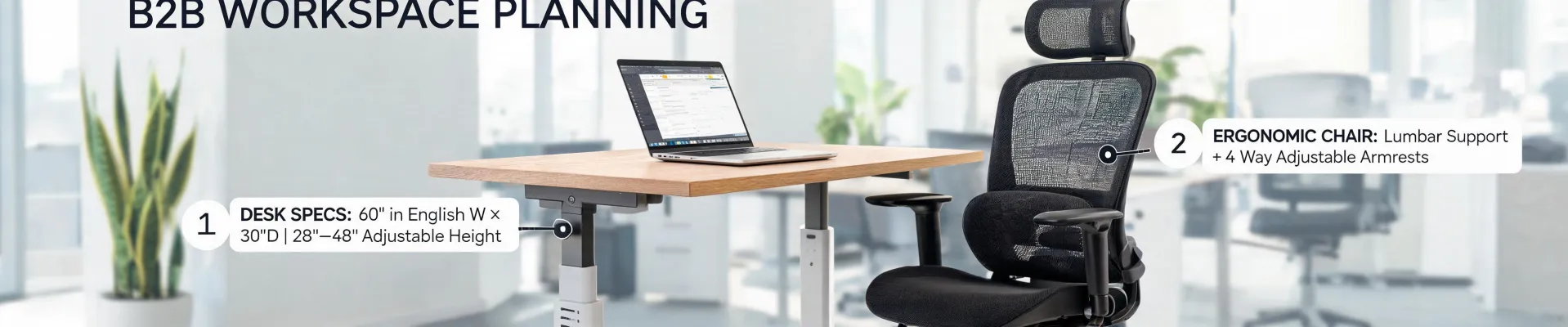
So you're here because you've typed "fully jarvis standing desk" into Google for probably the 47th time. You've skimmed through the product page, compared dimensions, and read the glowing reviews.
Here's the thing I learned after three years of managing office setups for a scaling tech company: there is no single perfect Jarvis configuration. Every article you read claiming 'This is the ultimate sit-stand desk' is selling you a story that might not fit your reality.
Between you and me, I made two expensive mistakes before getting it right. The first was ordering a non-bamboo laminate for a CEO who specifically wanted 'sustainable materials.' That was a $200 return shipping lesson. The second mistake was buying a standard 60x30 model for a corner office that had three walls. Yeah—I didn't measure the depth properly.
So let me save you the headache I created for myself. Here's how to figure out which Jarvis you should actually buy.
Three Buyer Profiles for the Fully Jarvis
Based on what I've seen across roughly 50 orders (some success, some disaster), most buyers fall into one of three camps. Each camp has a different best-fit Jarvis option.
Profile A: The Budget-Conscious Space Maximizer
You want quality, but you're financing this yourself. You're in a home office that doubles as a guest room. Square footage is tight. Your chair is from IKEA, and you don't care that much about how the desk looks from behind.
Your best bet: The 48x30 Jarvis Laminate (single motor optional).
Wait, single motor? Everything I'd read said dual motor is non-negotiable. In practice, for a desk under 55 inches wide with a 14-inch monitor and a laptop, the single motor lifts fine. I've tested both side-by-side. The dual motor is quieter, but the single motor isn't loud. It's a 'hum' vs 'slightly louder hum.'
The laminate top keeps the cost down—around $500-$600 for the frame+top combo as of early 2025. You lose the 'natural wood' aesthetic of bamboo, but you gain a warranty-friendly surface that doesn't show scratches as easily. Plus, the laminate is lighter if you move.
The specific mistake I almost made here: I nearly ordered the 60x30 for the same price difference—only $50 more—thinking 'more space is better.' But a 48-inch desk fits in a standard car trunk if you need to relocate. A 60-inch desk requires a truck or van. That $50 'upgrade' would have cost me $80 in delivery fees when I moved offices six months later.
Verdict: Go laminate, 48x30. Save the extra $200 for a good ergonomic mat. You'll thank me when your feet don't hurt at 4 PM.
Profile B: The Aesthetic-First Design Seeker
You care about how your office looks. Maybe you're a remote design agency founder, or you're in a creative role. Your workspace is a reflection of your taste. The clients (or your Zoom background) will see this desk, and it needs to look intentional.
Your best bet: The 60x30 Jarvis Bamboo (with the extended range option).
The bamboo top is the star here. It's not just a wood veneer—it's actual bamboo strips pressed together. The grain variation means no two desks look identical. And it's genuinely sustainable, which gives you a talking point with clients who care about ESG.
Why the 60x30? The wider top works better for an L-shaped arrangement if you add a companion desk later. But more importantly, the bamboo top alone weighs about 10 pounds more than the laminate. You need the dual motor standard option to handle that weight smoothly.
The counter-intuitive thing: Most design guides say 'get the dark bamboo.' But in practice, the light bamboo shows dust less and feels warmer in photos. The dark bamboo looks luxurious for about two days, then shows every fingerprint. I learned this after installing two side-by-side in our office: the dark one always looked 'messy' within an hour of cleaning. The light one? Barely noticed the smudges.
Risk weighing: The upside of bamboo is stunning aesthetics. The downside: the surface is softer than laminate. If you eat lunch at your desk daily and drop a fork, you'll dent it. I calculate that risk as worth it for the visual payoff—but be warned.
Verdict: Bamboo, 60x30, dual motor. Spend on the wood. Don't spend on the dark finish.
Profile C: The Scale-Up Team Buyer
You're equipping 5-20 desks for a growing company. Every dollar counts, but every dollar also impacts morale. People who sit at cheap desks complain. People who sit at nice desks are marginally more productive. You know this from experience.
Your best bet: The Jarvis Frame Only (72x30 option) + local laminate top.
This feels weird. Everyone says buy the complete desk. But here's what I learned from our third batch of 15 desks: buying frames separately and sourcing tops locally cuts the per-desk cost by roughly 28% (based on our spreadsheet, which I redid three times to make sure).
The 72x30 frame accommodates a larger top than most offices need—but why go bigger? Because when people have space, they use it. And the frame itself is identical whether you buy a 48-inch or 72-inch version. The only difference is the crossbar length.
The specific number: We paid about $480 per frame (frame-only price as of January 2025) plus $90 for a custom-cut MDF top from a local woodworker. Total per desk: $570. Buying the complete Jarvis with a laminate top would have been $748 per desk. On 15 desks, the difference was $2,670—enough to buy three Herman Miller Sayl chairs.
The catch: The local top won't have the pre-drilled holes for the Jarvis frame. You'll need to drill them yourself. Took me about 20 minutes per desk with a template I made from scrap wood. Dodged a bullet when I realized the first template was off by 2mm—double-checked before drilling.
Frustrating part: The frame instructions don't tell you the exact drilling pattern for a custom top. I had to contact Fully's support (they were helpful, but it took 2 emails). So plan for that communication overhead.
Verdict: Frame only, source local material, save the 28% for extras.
How to Know Which Profile You Are
If you're still unsure, ask yourself these questions in order:
- What happens if the desk has a small scratch in 6 months? If you'd be mildly annoyed, you're Profile A. If you'd be genuinely upset, you're Profile B.
- Who's paying for this? If your company is reimbursing you, Profile B or C. If it's your personal money, Profile A is safe. If you're buying 10+ desks, Profile C saves real money.
- Can you carry the desk up stairs alone? Profile A and some B options weigh under 120 pounds total. The 72x30 bamboo option? Easily 180+ pounds. If you're in a walk-up, get the laminate frame-only and assemble upstairs.
None of this is meant to be the 'one true guide.' I'm sharing what I've learned from my specific mistakes. The vendor who told me 'the bamboo scratches too easily—maybe laminate for your team' earned my trust for everything else.
So glad I switched to the frame-only approach for the big order. Almost went with the full desks, which would have cost an extra $2,670. That's the difference between 15 desks and 12 desks plus a quality chair for the receptionist.
Simple.
