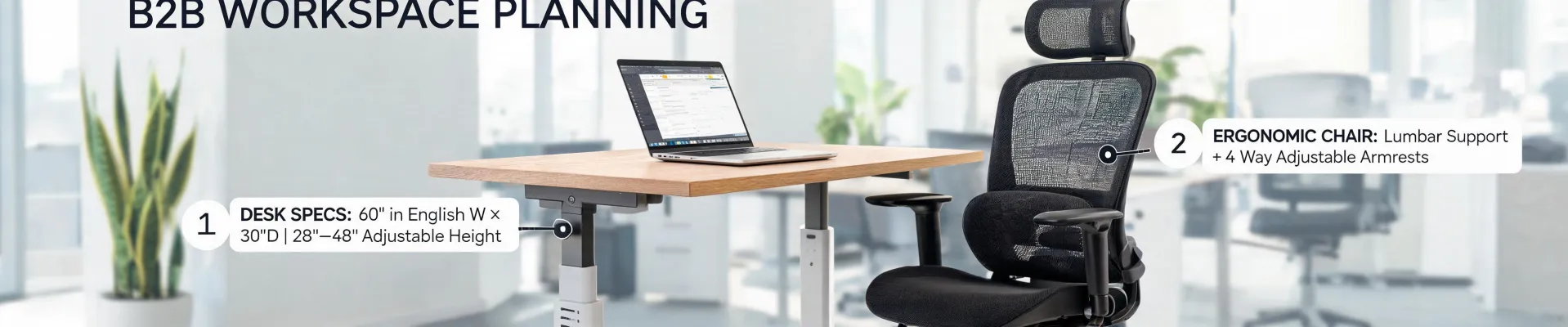
I'm the person who makes the office buy things. At a 14-person agency, that means I'm part procurement, part office manager, and part person who yells at the copier. I've watched a $42,000 annual budget for six years, negotiated with more vendors than I can count, and saved every order in a cost tracking spreadsheet that has way more color-coded tabs than it should.
So when we needed to replace two fixed desks with sit-stand desks, I didn't start with 'best standing desk 2025.' I started with 'what is this actually going to cost.' That's the question most reviews skip.
The Surface Problem: Is the Fully Jarvis Worth It?
Search 'fully jarvis laminate standing desk reviews' and you'll see the same themes: cable management, stability, appearance. I get it. But I read reviews differently. A review that says 'easy to assemble' doesn't tell me what happens when a motor fails. A five-star rating for the laminate top doesn't tell me if it will still look good in 2031.
The real problem isn't the desk. It's that we compare prices instead of costs.
Where the Real Cost Hides
When I compare quotes, I don't look at the big number first. I look for four things: what's included, what's excluded, how long it will last, and how painful the warranty process is. A standing desk quote is full of decoy pricing. One price is frame only. Another includes a top. Another includes shipping but doesn't mention that it ships to a freight dock, not your office. Another is 'free shipping' with a lead time that forces you into a rush order later.
Frame vs. top is the decoy that catches everyone
The most expensive mistake I almost made was comparing a frame-only desk from one brand to a complete desk from another. You have to ask if the top is included. If not, add $200 to $500 depending on material. A 'cheap' standing desk can become a 'not cheap' standing desk really fast.
For the Jarvis, the frame-only option is useful if you already have a top. But if you're comparing the fully jarvis hardwood standing desk to a competitor's complete desk, compare the same thing. I almost paid $140 more for a different brand because I compared their frame-only price to Fully's complete price. My fault. I now put a red flag in any comparison that doesn't say 'includes top' in the quote.
Laminate vs. hardwood is a use case, not a status symbol
I'm not a materials engineer, so I can't give you a 40-year durability prediction. What I can tell you from a procurement perspective is that top choice depends on how the desk will be used.
Laminate is easier to wipe down and costs less upfront. For a shared workspace where people spill coffee and drag boxes, laminate is the rational choice. That's not being cheap. It's being smart. On the other hand, a fully jarvis hardwood standing desk costs more, feels nicer, and can be refinished if it gets scratched. But hardwood is heavier, which means shipping costs more and moving it up a flight of stairs is a project. I learned this when a hardwood top from another vendor got stuck in an elevator lobby. We hauled it up three flights. That labor cost showed up in my calendar even if it didn't show up in the invoice.
To be fair, bamboo is the middle ground a lot of people love. My only advice: if you're paying a premium because it's green, ask what makes it green. Per FTC guidelines, environmental claims need evidence. Bamboo grows fast, but that doesn't tell you about the adhesives or finishes.
What Ignoring This Costs You
I still kick myself for saving $80 on a cheaper sit-stand frame in 2021. The frame was fine for about a year. Then the height adjustment started sounding like a blender stuck on puree. The warranty process wanted a video, then a photo, then a wait of 12 days for a replacement part that didn't fix it. I replaced the whole thing for $540. The $80 I saved cost me $550 and a lot of angry email threads.
A standing desk you won't adjust is a $900 chair. A standing desk that wobbles at height is a $900 excuse to sit. And a vendor that treats a one-desk order like a nuisance is a vendor that will treat a warranty claim like a court case.
This gets into logistics, which isn't my expertise, but even small numbers add up. According to USPS (usps.com), as of January 2025, a first-class stamp costs $0.73. That sounds like nothing. But chasing missing parts or a reimbursement form by mail costs a stamp plus ten minutes of admin time each time. Multiply that by a few vendor hiccups a year, and you've paid for a decent cable tray in wasted hours. The tool is only worth what it does for you over time.
And if you're a small company, the 'we only take bigger orders' attitude is everywhere. I've had vendors ghost me over a $2,100 order. Small orders are how good vendors build into bigger relationships. The ones that treat your first order seriously are the ones that will still answer the phone in year four.
A Short Solution: Buy the Jarvis With Your Eyes Open
We ordered a Fully Jarvis laminate desk for our operations manager and a frame-only Jarvis for our studio lead (we used a locally made butcher block top). I'm not going to pretend this is a long-term review. But the process was fairly straightforward: clear specs, no surprise shipping fee, and the cables actually fit in the tray.
If you're comparing options, do the cost-per-month math. I literally have a cpm calculator in my procurement spreadsheet. Take the total delivered price and divide by the number of months you expect to use it. A $1,100 desk used for seven years is $13.10 a month. A $750 desk replaced in three years is $20.83 a month. That's not a quadratic formula calculator problem. It's simple division.
Actually, I did use a quadratic formula calculator once when I was trying to compare two different desks with different lifespans and resale values. It was overkill. The simple division gave the same answer: the sturdier desk is often the cheaper one.
Bottom line: choose your top material by use case, not by review photos. Measure your space. Ask about lead time before you ask about price. And if a vendor makes you feel small because you're only buying one desk, that's a red flag.
Fountain Pens, Calculators, and the Same Lesson
I'll never teach a class on how to write with a fountain pen, but I bought one in 2023 and learned the first rule: don't press down. Let the nib do the work. Most people press too hard because that's what ballpoints require. You have to unlearn the habit.
A standing desk is the same way. The point of an adjustable desk is to actually adjust. If the desk makes you want to move, then the behavior it creates is worth the cost. If you park it at sitting height and ignore the controller, the extra $500 was a donation.
I'm not an ergonomist, so take this with a grain of salt. I can't tell you the perfect height for your elbows. What I can say is that a desk is a tool you'll touch every day for years. The numbers have to work, but the tool also has to make you want to use it. That's why I write my purchase justifications by hand with a fountain pen, then put the numbers in a spreadsheet. The small ritual makes the math feel less cold.
So, is the Fully Jarvis worth it? It can be. But only if you buy the version that fits your actual use case, calculate the true monthly cost, and treat your own time as part of the total. Skip the status top if you don't need it. Don't skip measuring your freight route or asking how the warranty process works. The desk is good. The thinking around it is what makes it a no-brainer.
