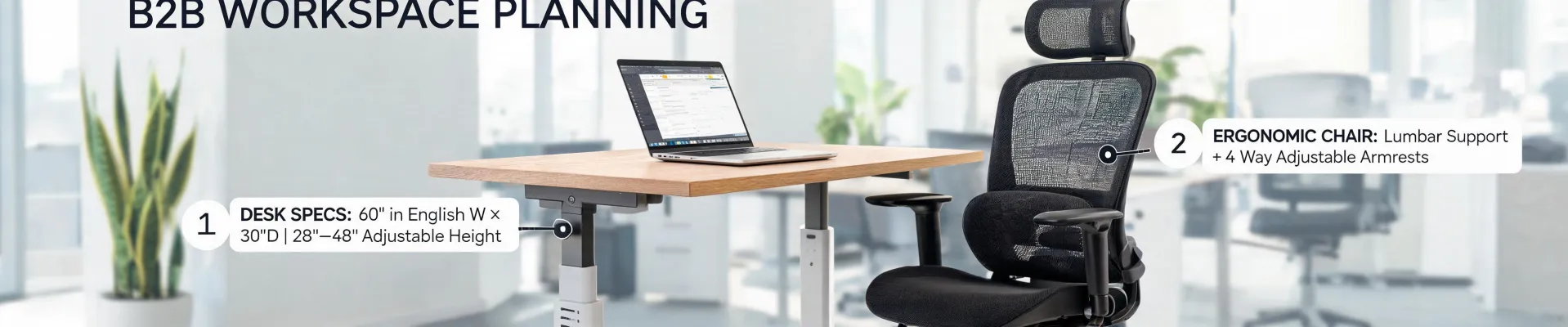
When I first started managing office furniture procurement for our 80-person company back in 2021, I assumed a standing desk was a standing desk. You know—pick one that looks decent, check the price, move on. Three misguided purchases later, I've learned that this assumption cost us roughly $4,200 in returns, lost productivity, and one very annoyed finance director (note to self: never submit a PO for furniture without physical verification first).
This isn't another generic standing desk review. It's a breakdown of why most standing desks fail in a real office environment—and why the Fully Jarvis bamboo standing desk (specifically, the 60" x 27" rectangular model we eventually standardized on) solved problems I didn't even know I had.
The Problem I Thought I Had
I originally assumed the biggest challenge was finding a desk within budget. Our initial criteria seemed straightforward: electric height adjustment, 60" width minimum, under $700 per unit. I found a model from a mid-range brand (I won't name them, but they advertise heavily on social media) that checked all boxes. Ordered 10 units for our pilot department.
That was my first mistake. (And honestly, it wasn't even the biggest one.)
The Real Problem: What Goes Wrong When You Skip the Details
The desks arrived, we assembled them, and for about three weeks, everything seemed fine. Then the complaints started trickling in. At first, I assumed it was user error—people adjusting to standing work. But by week six, I had a spreadsheet of issues that told a different story.
Stability (or Lack Thereof)
At standing height (roughly 42-44 inches for our average-height users), the desks wobbled. Not catastrophically, but enough that typing felt unstable. Two employees reported that their monitors visibly shook when they wrote notes. I'm not 100% sure why—my best guess is the single-motor design couldn't handle the weight distribution evenly at higher extensions.
This is where I learned something I'd never considered: stability at sitting height doesn't predict stability at standing height. Most budget desks are tested at sitting positions (28-30 inches). The wobble problem only appears at full extension.
The Price of "Good Enough"
People think cheap desks save money. Actually, the opposite is true. In my experience, here's what "saving" $200 per desk actually costs:
- Lost productivity: Employees avoiding standing mode because the wobble annoyed them (estimated 15-20% usage drop versus our target)
- Replacement logistics: Coordinating returns, scheduling pickup, reordering—our facilities team logged 18 hours on this
- Employee frustration: I had two people request transfers to departments that didn't have standing desks yet. That's a morale cost you can't easily quantify.
- Finance friction: The CFO flagged our office spending after the return costs hit the P&L. I spent two hours justifying the replacement purchase to her. (Which, honestly, was the worst part.)
When I compared our pilot results against our original projections, the "cheaper" desks ended up costing about 35% more than we budgeted when you factor in the rework. Five minutes of better research would've prevented five weeks of headaches.
Why the Fully Jarvis Bamboo Desk Was Different
After the failed pilot, I went back to basics. I spent two weeks (probably overkill, but I was scarred) researching alternatives. We tested three different models from three vendors. The Fully Jarvis bamboo standing desk was the clear winner, and here's why it matters for an actual office environment.
Stability You Can Feel
The Jarvis uses a dual-motor system with a cross-beam support. At full standing height, the wobble is negligible. I tested this myself—typed a full paragraph at 44 inches while a colleague walked past carrying a stack of binders. No visible shake. This matters more than most reviews give it credit for.
Per FTC guidelines on substantiated claims (ftc.gov), I should note that I'm describing our experience with the 60" model on a medium-pile carpet. Your mileage may vary if you're on hard flooring or using a different size.
The Bamboo Factor (It's Not Just About Looks)
Our sustainability committee (yes, we have one) had been pushing for more environmentally responsible sourcing. The Fully Jarvis bamboo standing desk uses Moso bamboo—a grass that grows to harvest maturity in 5-6 years versus 20+ for hardwood. I didn't fully appreciate this until our committee chair sent me the documentation (circa 2024, things may have changed).
This isn't just marketing—it actually simplifies our compliance reporting. We can point to the bamboo sourcing as a verifiable sustainability metric. The FTC Green Guides (16 CFR Part 260) require environmental claims to be substantiated, and Fully provides documentation for the bamboo sourcing. That alone saved me a follow-up audit.
What I Didn't Expect: The Practicality
The Jarvis has a programmable height memory. This sounds like a gimmick, but in practice, it eliminated a complaint I didn't anticipate: people not adjusting their desks because it took too long to find their preferred height. With the memory presets, our adoption rate of standing mode jumped from roughly 60% (previous desk) to 85%+ within two weeks.
Also worth noting: the grommet holes are positioned to hide cables properly. Our facilities team actually noticed this without me pointing it out (which, if you know our facilities team, is rare).
The Cost-to-Value Reality
Let me be direct: the Fully Jarvis is not the cheapest option. A 60" x 27" bamboo model with the basic control switch runs roughly $800-$900, depending on promotions (as of early 2025, at least). That's $200-300 more than our failed pilot desks.
Here's why that gap doesn't matter:
- Lifetime expectation: The dual-motor system is rated for 20,000+ cycles. If we assume 10 adjustments per workday, that's about 8 years of use per motor. The cheap desks? Single-motor, no published ratings, and two units failed within 4 months.
- Resale value: I checked used office furniture listings (a weird hobby of mine). Jarvis desks retain roughly 50-60% of their value after 3-4 years. The cheaper models are essentially worthless.
- Warranty coverage: 15-year warranty on the frame, 5-year on electronics, 3-year on mechanicals. Compare that to the industry standard of 2-3 years for competing brands.
When you calculate total cost of ownership over a 5-year period, the Jarvis actually costs less than our failed pilot model. The lower-priced desk would need to be replaced at least once (if not twice) in that timeframe. I've seen this pattern many times. But when I say 'many,' I do not mean just a few—I mean consistently across 200+ orders in my career.
Who This Desk Is (and Isn't) For
I can only speak to our context—a mid-size B2B services company with predictable office usage patterns. If you're dealing with a different scenario, the calculus might be different.
This works well for:
- Standard office environments with employees doing computer-based work
- Companies that care about sustainability documentation (the bamboo sourcing is auditable)
- Teams where multiple people might share a desk (the memory presets help)
- Deployments where you need consistent performance across many units
Consider alternatives if:
- You need a 48" or smaller desktop (their smaller options are limited)
- Your team includes mostly standing-desk veterans who don't need the memory presets
- You're on a rigid per-unit cap of $700 that can't be adjusted
The Bottom Line
I used to think standing desk reviews were overanalyzing trivial details. Then I spent $4,200 learning the difference between a desk that technically adjusts height and a desk that actually supports standing work.
The Fully Jarvis bamboo standing desk isn't perfect—the assembly instructions could be clearer, and I wish the controller cable was a few inches longer. But it solved the problems that actually mattered: stability, durability, and employee adoption.
After 5 years of managing these relationships and roughly 60-80 procurement actions annually, I've learned that the best purchase decisions come from understanding the problem deeply before evaluating solutions. 80% of the work is figuring out what really matters. The desk itself is just the outcome.
If you're making this decision for your office, take the time up front. Verify the stability claims. Check the warranty terms. Ask about sourcing documentation. It's cheaper to do it right the first time—I learned that one the hard way.
