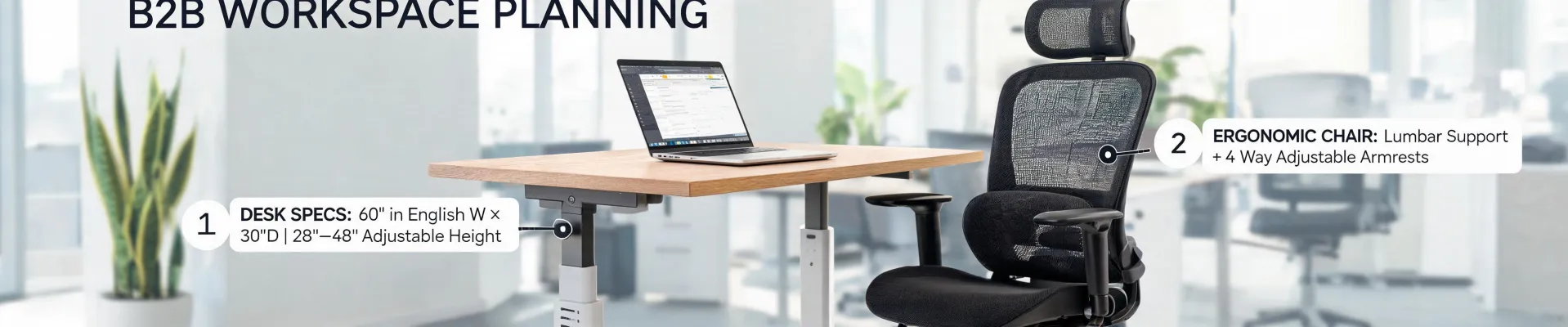
I have a slightly unpopular view in my line of work: the cheapest quote is rarely the cheapest purchase. I've managed procurement for a 47-person digital agency since 2019, and I've signed off on a few hundred orders. Our office and equipment budget runs around $210,000 a year. I've negotiated with dozens of vendors. I still kick myself for the times I picked the low number.
So when I reviewed the Fully Jarvis sit stand desk against cheaper standing-desk options, I wasn't comparing price tags. I was comparing what each desk would cost us in year three, year five, and year ten. The Fully Jarvis didn't win on the invoice. It won on total cost of ownership.
The wake-up call
In March 2023, one of our cheap sit-stand desks stopped lifting. The controller died, the desk was stuck at sitting height, and the employee who used it gave me a look I still remember. I didn't fully understand the cost of a bargain until that exact moment.
The desk had cost $349. The replacement controller was $210. The service call was $60. We lost four hours of productivity while we waited. When I added it up, that budget desk cost us $619 in 18 months. A Fully Jarvis frame, by contrast, is backed by a 15-year warranty that covers that kind of failure. That is the difference between owning an asset and renting a problem.
That incident changed how I evaluate equipment. Now every desk quote goes into our cost tracking system with columns for shipping, assembly, warranty, repairs, and disposal. Sounds like overkill for a piece of furniture. But I've watched too many managers treat the purchase order as the final number.
What total cost of ownership means for a standing desk
Here's my working definition: Price is what you pay. Total cost is what the product costs before it leaves your office. For a sit-stand desk, the TCO usually includes:
- Invoice price, including shipping and delivery fees
- Assembly labor, in loaded salary dollars
- Warranty quality, including how long it lasts and how painful it is to claim
- Expected failure costs for motors, columns, and controllers
- Productivity losses from a desk that wobbles, drifts, or stops working
- End-of-life cost, including disposal or moving the desk to another team
In Q3 2024, I put three standing desk vendors through that process for a 12-person team. The cheapest quote was 38% lower than the Fully Jarvis option on the invoice. But it came with dock-only freight, no installation support, and a 90-day warranty. Once I added the extra delivery fees and the labor our office manager would spend dealing with eight boxes, the gap shrank to less than 15%. Then I factored in the failure pattern we'd already logged on budget frames, and the Jarvis became the lower-cost option.
One warranty note: as of January 2025, Fully documents a 15-year warranty on Jarvis frames. That kind of detail looks small on an invoice and huge in a TCO spreadsheet. Verify current terms on Fully's site before you rely on them, but for us, it made the math easy.
If you're on a tighter budget, the frame-only option is a legitimate workaround. Pair a Jarvis frame with a local butcher-block top and you still get the lifting mechanism that does the heavy lifting. That's the sort of flexibility a TCO spreadsheet doesn't automatically show, but it's worth knowing.
Fully Jarvis standing desk aesthetics are worth money
I used to treat aesthetics as a nice-to-have. Not anymore. In late 2022, a senior designer left, and during her exit interview she said the office furniture made the company feel temporary. That stung. But she was right.
Employees read the office as a signal. A beige cubicle panel says we don't care. A desk with a warm bamboo top and a clean frame says someone thought about the people working on it. The Fully Jarvis standing desk aesthetics matter more to our employee satisfaction scores than the chairs did, and we bought better chairs too.
Fully is part of the MillerKnoll family, which also includes Herman Miller. That design lineage matters for our procurement file. We ordered the Jarvis in bamboo rectangular tops for most stations, plus an L-shaped Jarvis for two account leads who need extra monitor room. The mix looks intentional, not like a furniture auction.
I'm also careful about color matching. A screen cannot guarantee what a desktop color will look like in real daylight. Pantone's color-matching guidance says brand-critical colors usually need a Delta E of less than 2; a difference of 2 to 4 is visible to trained observers. On a laminate desktop, you are not going to hit printed-paper tolerance anyway. So I ask for samples before a large order. Fully's samples arrived quickly, and the color matched our interior plan. That is part of the total cost too.
Where to buy a printer: the same trap
This article is about desks, but the same TCO mistake happens with other office purchases. When someone asks me where to buy a printer, they usually expect me to name a retailer. I ask a different question: what is the cost per page?
A $49 inkjet printer with $0.18-per-page cartridges can cost about $1,399 over three years if you print 2,500 pages a year. A $279 laser printer with $0.03-per-page toner costs about $504 for the same volume. The cheap printer loses by $895, before you count the afternoon lost when an inkjet stalls during a client deadline. The next time you search where to buy a printer, skip the list and look for a cost-per-page comparison instead.
Not every calculator is worth using
I know the internet loves a good calculator. There is the female delusion calculator, the overtime calculator, and a hundred other tools that make complicated decisions feel objective. I get the appeal. But a calculator only tells you what you ask it. If the input is just the cheapest upfront price, the output is not a cost plan; it's a hope.
My TCO spreadsheet is not fun. It has 14 columns and rows for things like failure in year one and employee time lost because a desk motor sounds like a blender. But that spreadsheet caught the real cost of the bargain. It is the calculator I actually use.
And for the record, I did not need an overtime calculator to know that an employee who hates their desk is not going to produce their best work. I just needed to listen.
Okay, but what about a home office?
Let me address the obvious pushback. If you're buying a standing desk for a home office, you might use it only three hours a day, and you might be willing to accept the risk of a cheap frame. That's a defensible choice. I'm not here to tell everyone to spend money they don't have.
My argument is about commercial buying. When a desk is used eight-plus hours a day, the cost of failure is not just the replacement part. It is the interruption, the frustration, and the message that management doesn't care about the basics. Bottom line: I'd rather approve a desk that earns its keep than order another budget frame that ends up in the storage room.
The Fully Jarvis sit stand desk earned its place in our office because it is built for that workload. It didn't win because it was the cheapest quote. It won because when I ran the numbers, including the ones that never appear on an invoice, it was the least expensive desk we could buy. That's the version of value I can defend at any budget review.
