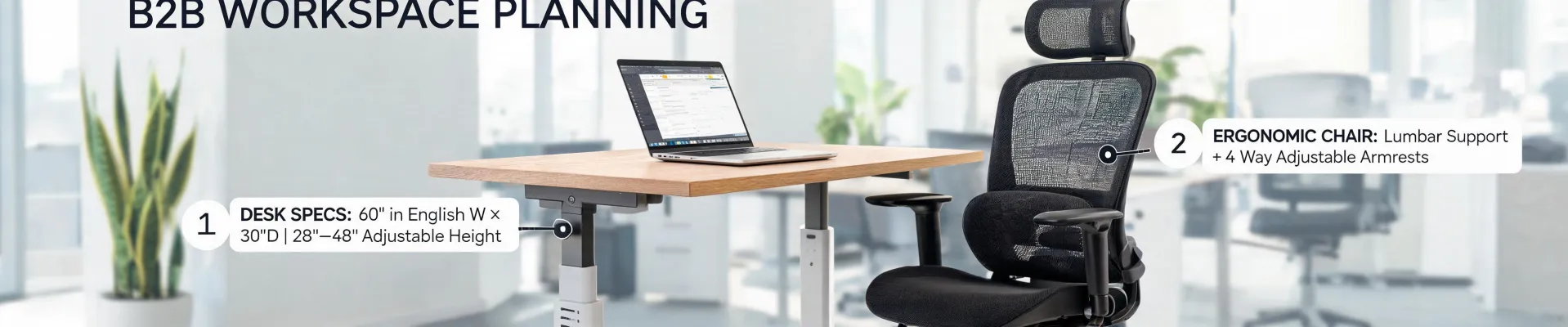
Let me say this upfront: If you run a small team or a startup, buying a Fully Jarvis isn't a luxury — it's a calculated investment.
I've managed procurement for a small tech company for the past six years, and I've tracked every single dollar in our cost tracking system (around $180,000 in cumulative office spending). In that time, I've reviewed quotes for everything from paperclips to enterprise software. So when our CEO asked me to look into standing desks for the team of 12 — we were expanding to 18 by Q3 2025 — I wasn't about to just pick the cheapest option. I've been burned by that route before.
My Experience: What My Spreadsheet Told Me
I looked at five different standing desk vendors. Three budget brands, one mid-range competitor, and Fully. On paper, the budget options were tempting — prices started around $350 for a frame-only setup. But I don't just look at base prices. I calculate Total Cost of Ownership (TCO) over 36 months. That means factoring in warranty coverage, service delays, and potential replacement costs.
The budget brands? Their warranty often covered the frame but not the motor. And the motor goes — I'd heard stories. One startup founder told me his cheap desk broke after 8 months; the replacement motor was $150, and he had to install it himself. That's downtime for an employee, which costs far more than the desk itself.
Here's where the Jarvis won, and it wasn't even close. Fully offers a 15-year warranty on the frame and 7 years on the electronics. For a small team where you're growing fast, that piece of mind is worth something real. With budget brands, you're lucky to get two years. When I calculated the TCO over 3 years, assuming even a single motor failure for the budget option, the Jarvis was cheaper. Period.
Why Small Orders Matter (And Why Fully Gets This)
When you're a small team, you're often treated like a nuisance. "Oh, you only want 6 desks? Your order is tiny." I've had vendors ghost me after asking for a quote on a smaller batch. It's frustrating. But my experience with Fully? Completely different.
When I reached out about ordering six Jarvis desks (bamboo tops, medium size, rectangle), the sales rep didn't push me toward a bulk order. She didn't make me feel like my $4,200 order was beneath them. She answered my questions about cable management and shipping timelines for the L-shaped options in case we needed them later. That's how you build supplier relationships. Today's $4,200 order can become a $20,000 order when you grow.
I want to say this is rare, but don't quote me on that — I've only worked with maybe 20 vendors in this category. I can't speak to how this applies to international sourcing. But for domestic needs, the Jarvis team acted like partners, not order takers.
The Bamboo Choice: Not Just for Aesthetics
The Jarvis bamboo standing desk is their standout model, and it's not just because it looks good. As a cost controller, I think about the resale value of our office assets. Bamboo is a hardwood that's durable and ages well. When we eventually upgrade our office (or if we're ever forced to downsize), a used Jarvis bamboo desk will sell for a much higher percentage of its original cost than a cheap laminate one. It's a slow depreciation asset.
Honestly, I'm not sure why more small teams don't factor in resale value. My best guess is they focus on the immediate cost, not the asset's lifecycle. In our cost tracking system, I saw that a $350 desk we bought in 2021 has no resale value today. The $750 Jarvis frame and top from 2020? I could probably sell it for $300–400 on a good day. That's nearly 50% retention after 5 years.
Don't Let the Price Tag Scare You
I know what you're thinking: "I can buy two budget desks for the price of one Jarvis." I had that same thought. In Q2 2024, when we were comparing quotes for our new offices, I found a budget option for $400 each. The Jarvis was around $750. My first reaction was to go for the cheaper one. But I've made that mistake.
Saved $350 by skipping the premium option? Ended up spending $500 on expedited shipping and reordering when the cheap desk arrived with a wobble that made typing impossible. The 'budget' choice looked smart until the first employee complained of eye strain from the screen shake. Net loss: Time, productivity, and $200 more than the Jarvis would have cost.
The base pricing for a Jarvis frame-only starts at around $550, and a full desk with a bamboo top is about $750–$900 depending on size, as of March 2025. Verify current pricing directly, as rates may have changed. But honestly, $750 for a desk that will hold its value and has a 15-year warranty? That's not expensive. That's cheap in the long run.
Addressing the Pushback: "We Can't Afford Quality"
I hear this a lot from other small procurement managers. "We need to be scrappy." I get it. I've been there. But scrappy doesn't mean buying garbage. Scrappy means investing the money where it matters most. Your desk is where your team spends 8+ hours a day. If you're asking them to stand for better health, cheaping out on the desk is ridiculous.
It's like buying a cheap printer for a design studio. You'll eventually spend more on reprints and frustration. The Jarvis isn't a vanity purchase; it's a reliability purchase.
My Bottom Line
If your budget is tight, I'd rather recommend buying two Jarvis desks for your key people now and getting cheaper temporary tables for others than buying six budget desks that'll need replacing in two years. It's not about spending less; it's about spending smarter. The Fully Jarvis is the smartest buy in this category for a small team, hands down.
And when you go to reorder for your next hire — and you will — they'll actually thank you for it.
