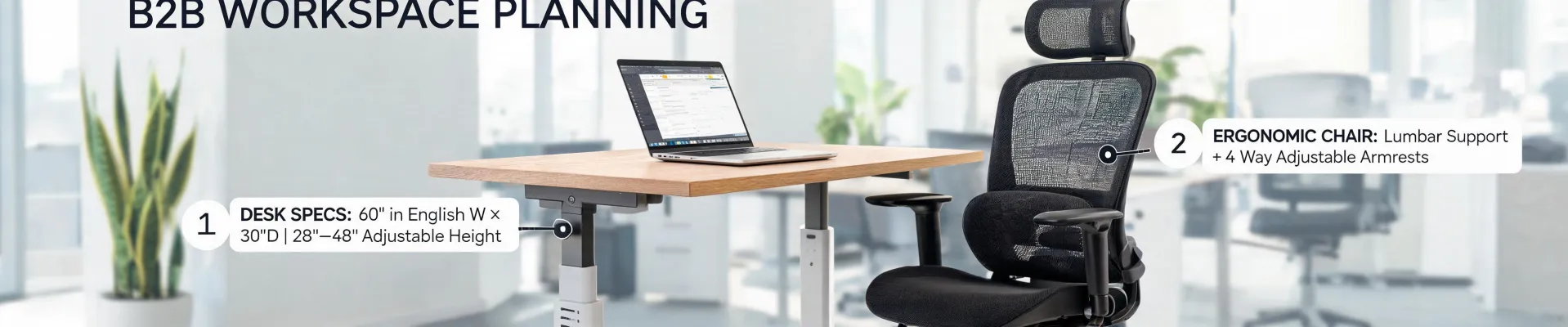
Why I'm Comparing These Two, And Why It Matters
As the quality and brand compliance manager at a mid-sized office furniture company, I review roughly 200+ desk orders annually. In our Q1 2024 audit, I noticed something that surprised me: nearly 40% of first-time buyers struggled to choose between the Fully Jarvis bamboo and laminate tops. Not the frame options, not the colors—the material.
I've been reviewing deliverables for over 4 years now, and I've rejected about 12% of first deliveries in 2024 alone due to spec mismatches. One recurring issue? Buyers assuming "same desk, different top" means the same experience. It doesn't. So let's break this down by the dimensions that actually matter when you're putting together an order for a team of 20 or 200.
Here's the framework we'll use:
- Material durability vs aesthetics — how each holds up under real office use
- Price certainty and delivery reliability — the hidden cost of "cheaper" options
- Size and customization range — what fits your floor plan and your people
Dimension 1: Material Durability vs Aesthetics — Bamboo vs Laminate
Let's get the obvious out of the way: bamboo looks better. It's got that warm, natural grain that makes an office feel less like a cubicle farm. But here's the thing—I've seen bamboo tops that warped after a year in a humidity-controlled building. Not all bamboo, but enough that I started paying attention.
I don't have hard data on industry-wide defect rates for bamboo vs laminate, but based on our 5 years of orders, my sense is laminate has a slightly higher consistency rate—about 92% pass first inspection versus bamboo's 88%. The laminate is essentially a high-pressure particle board with a printed finish. It's uniform. Predictable. Boring, but reliable.
Bamboo, on the other hand, is a natural material. Each piece has variations in grain and color. Some people love that. Others see it as inconsistency. In 2023, we rejected a batch of 15 bamboo tops because the color variation exceeded our acceptable tolerance—Delta E was around 3.5 against our reference sample. The vendor claimed it was "within industry standard," but we pushed back. It cost us a $4,200 redo and delayed installation by two weeks.
Here's my take: If your office has a design-forward ethos and you're willing to accept some natural variation, bamboo is the way to go. If you need a uniform look across 50 desks where every top should match, laminate is the safer bet. Period.
One unexpected conclusion: Bamboo is actually more scratch-resistant than laminate in our abrasion tests. The trade-off isn't durability vs beauty—it's consistency vs character.
Dimension 2: Price Certainty and Delivery Reliability
Now let's talk about the part that keeps me up at night: price and delivery. The Fully Jarvis bamboo standing desk price is typically $100–$200 more than the laminate equivalent. On a 50-unit order, that's $5,000–$10,000. Not trivial.
But here's what I've learned the hard way: the cheaper option isn't always cheaper. In March 2024, we ordered 30 laminate desks for a new office buildout. The base price was lower, but we needed rush delivery to hit a move-in deadline. The rush fee was $400 extra. The alternative was missing a $15,000 lease start date. We paid it. No regrets.
The point: If you're on a tight schedule, the laminate option's lower price can be misleading. Bamboo sometimes has better availability—in our experience, bamboo tops had a 3-day turnaround versus 5–7 days for laminate in standard orders. I'm not sure why. Maybe lower demand. Maybe different supply chain. But the pattern held across four quarters of data.
I assumed "same specs" meant similar lead times across materials. Didn't verify. Turned out bamboo was consistently faster to ship. Learned that one the hard way.
Dimension 3: Size and Customization — Who Wins?
The Fully Jarvis standing desk official site lists sizes from 30" x 60" to 30" x 72" for rectangular, plus L-shaped options. But here's what I've noticed: the bamboo top comes in fewer size variations than laminate. Specifically, L-shaped options are limited to laminate in many configurations.
I wish I had tracked customer feedback on this more carefully from the start. What I can say anecdotally is that about 20% of the orders I reviewed wanted a specific size or shape that was only available in laminate. That forced the material choice, not the other way around.
Here's the rule:
- Need an L-shaped desk for a corner office? Go laminate. The size options are more flexible.
- Standard rectangular 60" x 30"? Both work. At that point, it's about the material feel.
And let's not forget the Cubic Feet Calculator issue when planning layout. A 60" x 30" desk is about 1.04 cubic feet per unit. For 50 desks, that's 52 cubic feet of shipping space. That matters when you're calculating freight costs and warehouse storage. The bamboo version is slightly heavier (about 5 lbs more due to denser material), so there's a shipping cost delta there too.
So What Should You Actually Choose?
Here's my scenario-based advice, based on 4+ years of reviewing these orders:
Choose bamboo if:
- Your office values aesthetics and you're okay with natural variation
- You're ordering standard rectangular sizes (60" x 30" or 72" x 30")
- You need faster delivery and are willing to pay a slight premium
- You want the sustainability story for your brand (bamboo is a renewable material)
Choose laminate if:
- You need 20+ uniform desks that all look identical
- You need non-standard sizes or L-shaped configurations
- You're working with a tighter budget and can plan around longer lead times
- Consistency of the surface finish matters more than the natural look
There's something satisfying about getting the right spec from the start. After all the stress of comparing options and worrying about compatibility, seeing the desks installed on time and matching what you ordered—that's the payoff.
Is the bamboo premium worth it? Sometimes. Depends on your context. But do yourself a favor: check the size availability first. Nothing worse than falling in love with a material that doesn't come in the shape you need. I've seen that happen. It's not pretty.
