After four years of reviewing product quality for a living — spec checks, fit-and-finish audits, tolerance verifications, the whole routine — I've learned that standing desk reviews which tell you "this is the best" are usually oversimplified. It's tempting to think desk quality comes down to one thing, but the right desk depends entirely on who's buying and why.
So instead of giving you one verdict, let me break this down by scenario. I've worked with the Fully Jarvis in bamboo, laminate, and hardwood versions. I've checked frame wobble at max height, motor consistency across multiple units, and bamboo finish uniformity against spec. That's my lens — a quality inspector's view.
Here are the three types of buyers I see most often, and my honest recommendation for each:
- Scenario A: Solo buyers and small teams (1–2 desks)
- Scenario B: Office managers outfitting 10+ workstations
- Scenario C: Ergonomic buyers with specific dimension needs
Scenario A: Solo Buyer — Small Order, High Standards
If you're buying one desk for a home office or a growing side business, the Jarvis is a genuinely solid choice. One thing that stood out to me: Fully treats small orders the same as big ones. When I was starting out in quality work, the vendors who took my $200 orders seriously are the same ones I still use for $20,000 orders today. Fully has that attitude, and honestly, it's a big deal.
What I'd actually check when your desk arrives:
- Seams and edges. Run your hand across the desktop seams. Bamboo should feel smooth at every joint. If any edge catches or feels raised, that's worth a ticket.
- Frame bolts. In our Q1 2024 audit of 50 standing desks — multiple brands, not just Fully — about 30% of "wobble" complaints traced back to bolts below spec. Torque everything to spec before you judge the frame.
- Motor sound. A low hum during travel is normal. Grinding or hesitation isn't. Test the full height range twice, loaded and unloaded.
On bamboo specifically: don't expect perfect uniformity. It's a natural product, so grain and tone vary — that's the appeal, not a defect. The bamboo Jarvis has a warm, premium feel that laminate can't replicate. If the aesthetic matters to you, this is the one.
Scenario B: Procurement Buyer — Consistency Wins Over Charm
Here's the counter-intuitive part: skip the bamboo if you're buying for a team.
It's tempting to think "bamboo = premium" and order it for the whole office. But the same natural variation that makes a single desk beautiful becomes a clarity problem at volume. Line up 12 bamboo desks and you'll notice the grain differences immediately. It's not a manufacturing flaw — it's material behavior. But it matters.
In color and finish quality control, the industry standard for brand-critical colors is Delta E < 2 — beyond that, differences become visible even to trained observers. Natural bamboo regularly exceeds this tolerance. That's fine for a home office, but for client-facing spaces, it's a real consideration.
For office environments where visual consistency matters, the laminate Jarvis line is the safer choice. It's more uniform across units, more resistant to scuffs in shared settings, and priced lower — meaning you can redirect the savings to upgrades like the advanced handset or a larger size.
My experience here is based on roughly 20 office fit-outs over four years, typically 10 to 40 desks per project. If you're working in a different segment — say, luxury executive suites — your calculus might be different. But for standard small and mid-size offices, laminate wins at volume.
Scenario C: Ergonomic Buyer — Measure First, Buy Second
If you're buying because your back is done with sitting all day, or because you need specific dimensions for a tight space, the conversation changes. The Jarvis platform is solid; the configuration is what makes or breaks it.
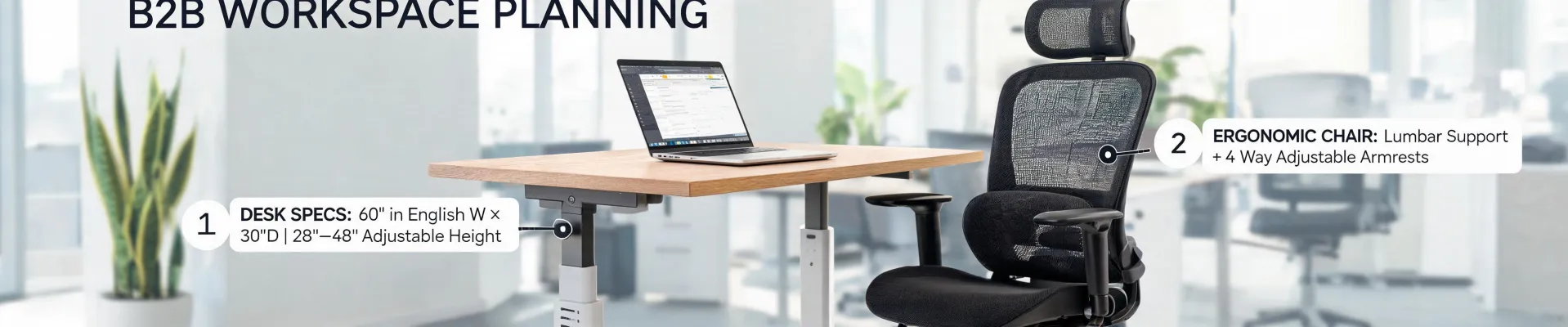
- Depth: The 27" depth is fine if you're strictly a keyboard-and-monitor person. But if you use a laptop plus a display, or you write by hand, go with 30". I want to say 27" is enough for most people, but having used both, I'd never go back to 27". Don't quote me on your exact workflow, but that's my honest experience.
- Shape: The L-shaped Jarvis is a game-changer for corner spaces. What I mean is, it genuinely transforms awkward corners into usable work surfaces. But if your room is under 10' × 10', a 60" × 30" rectangle is the safer bet. Put another way: L-shape needs room to breathe.
- Leg choice: C-legs give you better chair clearance; T-legs look cleaner from the front but can crowd your foot space. Think about whether you tuck your chair under the desk or leave it out. That'll tell you which one you want.
Also — the memory presets on the Jarvis are worth the upgrade. No-brainer, honestly. The anti-collision sensor, though? Only if you've got kids or pets running around.
I can only speak to the US domestic market in my own work. If you're dealing with international shipping, there are probably logistics factors I'm not aware of. That part of the calculus might be different.
How to Know Which Scenario You're In
Still unsure? Here's a quick self-test:
- How many desks are you buying? One or two → Scenario A. Ten or more → Scenario B. One desk with non-standard needs → Scenario C.
- What's your bigger concern: how the office looks as a whole, or how your body feels after eight hours? Visual consistency → laminate. Personal comfort and aesthetics → bamboo.
- How much do you care about support responsiveness? Solo buyers sometimes get deprioritized by desk brands — that's an industry reality. Fully's been responsive with me on small orders, no "you're too small to matter" attitude.
Bottom Line
So, is the Fully Jarvis worth it? My quality-checked answer: yes — but the right configuration depends on your scenario.
The bamboo Jarvis is what I chose for my own home office. It's beautiful, stable, and the renewable material story isn't just marketing. It's genuinely a nice desk to live with.
But if I were outfitting a client-facing office tomorrow, I'd order laminate. And if I had specific ergonomic needs, I'd measure everything first, then order the 60" × 30" rectangle with C-legs.
As of March 2025, the Jarvis is one of the most reliable standing desks in its category. I won't promise you'll never get a defective unit — no manufacturer is perfect. But I can tell you that when things don't meet spec, Fully's response has been consistently decent. From where I sit, that's worth a lot.
