-
Dimension 1: Total cost over three years — where "cheap" stops being cheap
-
Dimension 2: What the ergonomics are actually worth
-
Dimension 3: Build quality — and what the warranty actually tells you
-
Dimension 4: Fit and customization — where the budget category disappears
-
The decision tool that keeps me honest
-
So which one should you buy?
Every few weeks, somebody on our ops team asks the same question: "What's the best standing desk we can buy?" They ask me the same thing about printers: what is the best printer? The question sounds reasonable. It isn't, not on its own. "Best" isn't a property of the product. It's a match between the product and your constraints: budget, usage, lifespan, and the people who actually use it.
I've managed procurement for a 120-person software company for six years. In that time I've tracked about $180,000 in cumulative office equipment spending, placed 70+ desk and chair orders, and built a cost spreadsheet that flags hidden fees before they hit an invoice. This piece is my head-to-head between the Fully Jarvis and a typical $399 budget standing desk. I'll compare them on four dimensions: three-year total cost, ergonomic return, build quality and warranty, and fit.
One more thing before the math: I'm not going to declare a universal winner. Anyone who tells you one desk is best for every workplace is selling something.
Dimension 1: Total cost over three years — where "cheap" stops being cheap
Start with sticker price. The budget desk is $399. The Jarvis starts at roughly $499 for the frame only, and a complete desk typically lands in the $650–$800 range as of March 2025 on the Fully Jarvis standing desk official site — fully.com. Those prices shift, so verify them before you finalize a purchase order.
Now the part people skip. The budget desk we tracked came with a $99 shipping fee. It arrived with a damaged grommet — we didn't catch it until after the return window closed. The controller board failed in month 22. The replacement motor was $180. Add the office manager's time on warranty calls and the vendor's "diagnostic fee" (yes, that's a real line item), and the $399 desk cost us roughly $710 over three years.
The Jarvis? The order I tracked shipped free. Five years in, the unit in our demo office hasn't needed a single repair. At $749 purchased outright, the three-year cost is $749. That's the counterintuitive part: the budget desk costs more per year of useful life. It isn't cheap — it's just cheaper on the day you pay for it.
The $399 desk cost $710 over three years. The $749 Jarvis cost $749 — and it's still running. Cheaper on the day, more expensive over time.
There's also the tax layer. For a business, office furniture is typically a deductible capital expense; under IRS Section 179, you can usually expense it fully in the year of purchase. I keep a small after-tax (AFT) calculator in my procurement spreadsheet. At a 21% federal corporate rate, the Jarvis's effective cost drops to roughly $592. The budget desk gets the same deduction, but with a shorter expected lifespan, the per-year benefit is smaller. I wish more buying guides showed this math, because it genuinely changes the conversation.
Dimension 2: What the ergonomics are actually worth
Here's where I'll flag a data gap: I don't have hard numbers on productivity uplift. We never ran a formal A/B test, and I'm not going to invent one. What I can say, anecdotally, is that in our Q2 2024 internal survey, 17 of 22 people with sit-stand desks said they used the standing function at least twice a day. Nobody regretted having the option.
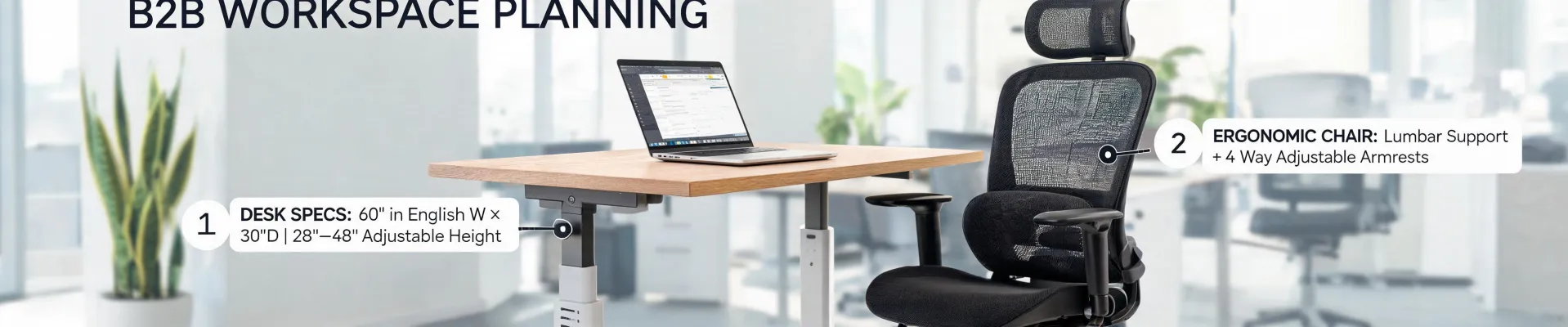
The Jarvis has a wider height range than most budget desks — a real difference unless everyone on your team is roughly the same height. A 6'4" engineer and a 5'2" office manager can't comfortably share a desk that only adjusts between 27 and 45 inches. The Jarvis frame's published range covers both. Budget desks often cut this corner: a shorter adjustment range that literally excludes part of your staff.
The health economics matter even without my survey. OSHA and Cornell University's ergonomics guidance both recommend alternating sitting and standing through the day. The desk's job is to make that easy. The Jarvis's motor transitions are smooth — which sounds like a luxury until you've used a budget desk that jerks, rattles, and makes you hesitate before pushing the button.
I don't want to oversell this. A desk is not a wellness program. But one ergonomic injury claim — a shoulder issue, a back flare-up — easily exceeds the price of a good desk. That's not speculation; our workers' comp premium quoted us the real number after our last claim.
Dimension 3: Build quality — and what the warranty actually tells you
In my first year of procurement, I made the classic spec mistake: I approved a "heavy-duty" standing desk based on the weight capacity in the listing, without checking how it behaved at full height with real equipment. It wobbled every time someone typed. That cost me a $600 reorder and two weeks of annoyed engineers.
This is the reality of budget desks — not that they're always bad, but that you can rarely verify what you're getting. The Jarvis is rated for 350 pounds, and the spec sheet is explicit about motor configuration, frame construction, and BIFMA X5.5 durability testing. Budget listings say "sturdy." That is not a specification.
Warranty terms tell you what the manufacturer expects the product to survive. Fully (now a Herman Miller company) publishes its warranty terms in plain language on the official site; as of my last check in March 2025, the frame and drive components were covered well beyond the one-year term you'll see on a $399 desk. I've never seen a budget standing desk vendor offer comparable coverage. That asymmetry is information.
Side note: we didn't have a formal warranty-claim tracking process until the third time a motor died. I built a simple spreadsheet after that. Should have done it after the first. If you're buying for more than a handful of people, start that log on day one.
Dimension 4: Fit and customization — where the budget category disappears
The fully-jarvis lineup covers rectangular and L-shaped frames, bamboo, hardwood, laminate, several colors, and a frame-only option if you already have a top you like. The bamboo top is a genuinely different offering — renewable, durable, and it looks like real wood because it is real wood.
Budget standing desks mostly come in one size, one shape, and a handful of colors. If your space has odd dimensions or your team has preferences, that constraint becomes a hidden cost: you either compromise on what people get, or you spend more than you saved trying to retrofit.
The L-shape is the clearest example. A budget L-shaped standing desk under $600 is rare, and the one I tested had disappointing stability at the corner joint. The Jarvis L-shape is more expensive — no argument. But if your team actually needs L-shaped workstations, the budget category doesn't have a serious contender. That's not "expensive vs. cheap"; it's "exists vs. doesn't exist."
The decision tool that keeps me honest
When I say I "compared" desks, I don't mean I ranked them by feel. I build a pairwise comparison matrix using the same logic as the Analytic Hierarchy Process. You compare each criterion against each other on a 1-to-9 scale — "is reliability more important than price, and by how much?" — then calculate the principal eigenvector of that matrix. The normalized eigenvector gives you the weight of each criterion.
I have an eigenvector calculator built into my procurement spreadsheet, so the math takes about two minutes. For our last desk refresh, the weights came out to: reliability 0.41, total cost 0.33, ergonomics 0.18, aesthetics 0.08. You might weight them differently — that's fine, that's the point. The method makes your priorities explicit instead of leaving them buried inside a gut feeling.
I use the same framework when people ask about printers. Print volume, cost per page, service response time, reliability — the "best" printer is the one that wins once you apply your weights. The best printer for a legal office isn't the best printer for a construction trailer, and neither answer is wrong.
This process has caught my own bias more than once. I expected aesthetics to rank higher in our desk evaluation. The math said the team cared far more about reliability. That's exactly why I run the numbers instead of trusting my instincts.
So which one should you buy?
If you have seven minutes, run your own matrix. But here's my honest guidance.
Choose the Fully Jarvis if:
- People at those desks work five or more hours a day — which, let's be honest, is almost everyone at your company.
- You need L-shaped or non-standard configurations.
- Your team has diverse heights and needs a wide adjustment range.
- Sustainability commitments matter, and bamboo is a material you can point to in a quarterly report.
- You're furnishing a space you'll be in for more than two years.
Choose a budget desk if:
- The desks get occasional use — a break room, a training space, a workspace for visitors.
- You're outfitting a short-term lease and the furniture won't move with you.
- You have a hard CAPEX ceiling and you've accepted, explicitly, that you'll probably replace these desks within two years.
What I won't tell you is that the Jarvis is the best desk for everyone on earth. It isn't. But when people ask me "Fully Jarvis or the cheaper option?", they're usually comparing the wrong numbers. Sticker prices instead of three-year totals. Before-tax instead of after-tax. Initial excitement instead of replacement probability. When I run the real numbers, the gap narrows dramatically. Sometimes it even reverses.
Over the past six years, I've replaced more budget desks than I can count. I've never replaced a Jarvis. That's not marketing. It's just the log.
