-
Why most Jarvis reviews don't help you
-
The TCO habit that changed the way I buy desks
-
Scenario 1: the rectangular desk for a single wall
-
Scenario 2: the corner worker and the Jarvis L-shaped standing desk
-
Scenario 3: the frame-only option when you don't need a new desktop
-
How to tell which scenario you're in: a 10-minute test
If you searched for "Fully Jarvis standing desk reviews" because you want a straight answer, here's the first thing to accept: there isn't one answer. There are three, and the one that's right for you depends on your room, your workflow, and what you already own.
I'm the operations person for a 34-person architecture and interiors studio. I've been ordering office furniture since 2019, and in that time I've personally made—and, yes, documented—four significant buying mistakes that add up to roughly $9,600 in wasted budget. I'm now the one who maintains our team's standing-desk checklist, so this post is my attempt to keep you out of my old spreadsheets.
Why most Jarvis reviews don't help you
Most reviews lump all sit-stand desks into one "best standing desk" race. They compare a bamboo top against a laminate top, talk about stability at max height, and finish with a score. That's fine if every buyer has the same desk in the same 10-foot-wide office. In the real world, the Jarvis product line covers at least three different jobs.
- Scenario 1: one person working along a single wall. What you need is a standard rectangular Jarvis with a well-matched top.
- Scenario 2: a workflow that wraps a corner. This buyer should be looking at a Jarvis L-shaped standing desk, not a longer rectangle.
- Scenario 3: you already own a quality desktop. The smarter buy may be a frame-only Jarvis rather than a whole new desk.
Once you know which scenario you're in, the reviews that matter change completely. The mistake is reading them before you've even decided which desk problem you're solving.
The TCO habit that changed the way I buy desks
Purchase price isn't cost. That sounds obvious, but I've watched our own purchase orders prove it over and over. The desk that seemed cheap on the invoice was often the most expensive one in the building after delivery delays, missing accessories, and a replacement order.
I now calculate total cost of ownership before comparing any vendor quotes. The TCO number includes more than the price tag:
- Order cost. The frame, the top, and anything you add to make the desk usable.
- Logistics. Shipping, freight liftgate fees, assembly time, and the dreaded delivery reattempt.
- Setup time. Your team member's hour or two of assembly is real money, even if no invoice shows it.
- Mistake risk. If you order the wrong depth, the wrong shape, or the wrong configuration, you pay twice.
- Service life. A desk that fails after 18 months costs more than a desk that lasts through two office moves.
The cheapest quote is rarely the lowest TCO. And the most expensive one isn't automatically the best, either. The point is to stop comparing price tags and start comparing outcomes.
Scenario 1: the rectangular desk for a single wall
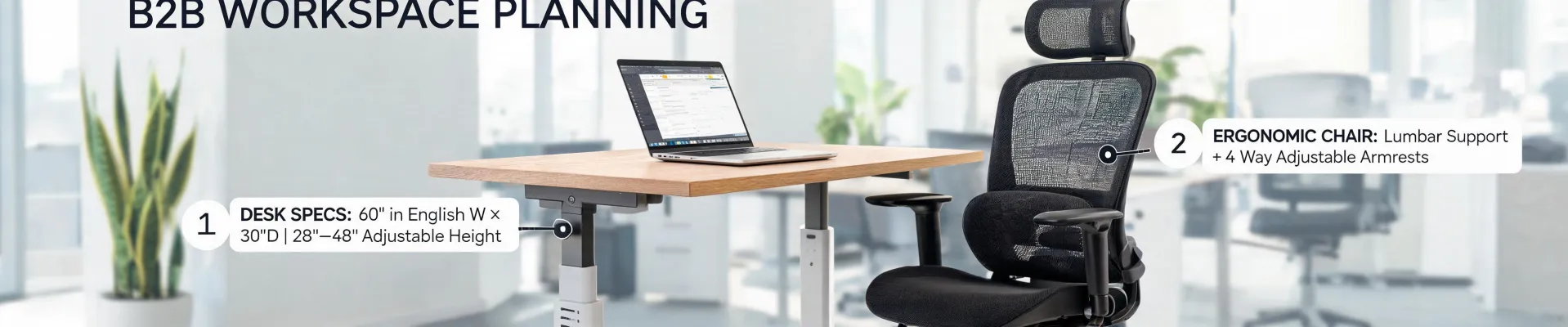
If you have a dedicated wall and your work happens in one main position, a rectangular Jarvis is the appropriate default. This is the scenario most reviews assume, and for once the default answer is usually right. You just need to get the details right.
The mistake I keep seeing—and made myself in 2020—is choosing a smaller desktop to save floor space. On paper, it looked fine. The monitor was 27 inches, the keyboard was compact, the room was small. When the monitor arm got clamped, the notebook stack appeared, and the coffee mug found its permanent spot, there was nothing left. We reordered a deeper top, paid freight, and turned the first top into a very expensive shelf.
If you're in this scenario, think about the depth before you think about the width. A slightly deeper desktop gives your arms somewhere to land when you're standing. That matters more than an extra few inches of horizontal space.
On materials, I'll correct a myth while I'm here: a bamboo surface is not automatically tougher than a laminate one. People carry over the belief from bamboo flooring marketing. But a desktop lives a different life. Laminate—especially a good HPL surface—will shrug off coffee rings and scuffs that would send a natural wood or bamboo finish to the repair kit. That isn't an attack on bamboo. Bamboo is one of the best-looking surfaces we've hosted in our studio, and the sustainability story is real. It's just not the right material for every desk, especially if the desk is shared or the person eats lunch at it.
So for Scenario 1, buy the rectangular shape, prioritize depth, and choose the surface based on how the desk will actually be treated—not just how it photographs.
Scenario 2: the corner worker and the Jarvis L-shaped standing desk
The L-shaped Jarvis gets treated like an executive perk. I think that's backwards. An L-shaped standing desk is for anyone whose workflow wraps around a corner: keyboard facing one wall, second screen or documents on the adjacent wall, and your body rotating between the two.
I resisted this for years. I went back and forth on a senior designer's L-shaped request for about two weeks. On paper, a large rectangular desk against one wall was cheaper, and the second wall could hold a bookshelf. My gut said the corner workflow needed the corner surface. Eventually I gave in and ordered the Jarvis L-shaped standing desk. Within a month, the designer told me she'd stopped twisting her whole torso to see her reference monitors. The desk matched her natural movement instead of fighting it.
The pitfall with L-shaped desks isn't the shape. It's the path the desk takes to get into your room. In September 2022, I ordered three L-shaped Jarvis desks for a new floor. I measured the office doors. I measured the room. I forgot to measure the hallway turn. One carton couldn't make the final 90-degree corner without tilting, and the delivery team refused to risk damage. That reattempt cost us around $200 plus a week of schedule chaos.
Now every L-shaped order includes a route check: doors, elevators, stairwell landings, and the turn into the final room. It sounds like a logistics detail. It is a logistics detail. And it belongs in your TCO calculation.
One more thing: don't assume an extra-wide rectangle is the cheaper way to fake an L. If your work genuinely turns a corner, you'll end up adding a side table or a second desk anyway. At that point, you've paid more and used more floor space than the L-shaped solution would have cost upfront.
Scenario 3: the frame-only option when you don't need a new desktop
Here's the contrarian take in this review: the greenest Jarvis desk might be the one without a Jarvis top on it.
If you already own a solid, well-built desktop—the kind of 60-inch by 30-inch surface that used to be standard office furniture—you don't necessarily need a full package. A frame-only Jarvis turns your existing top into a sit-stand desk without sending the old top to a landfill.
I know it feels more exciting to order the complete desk. But the frame is the part that does the mechanical work. The top is just the surface. If your current surface is solid, laminated, or hardwood in good condition, replacing it with a brand-new top is exactly the kind of purchase I now avoid.
Per the FTC Green Guides (16 CFR Part 260), broad environmental claims need to be substantiated. I don't buy "eco-friendly" marketing at face value, and I apply the same standard to myself. Keeping an existing desktop in service is more honest than replacing it with a new "green" top while the old one heads to the dump.
This is also a budget-friendly route if you're transitioning from a fixed desk. Frame-only packages typically cost less because you're not paying for a new surface, packaging, or the freight weight of a slab of wood. The tradeoff is that you have to verify your existing top is structurally sound and the right size for the frame. If it wobbles or bows, you'll feel it at standing height. But if the old top is solid, frame-only is a quiet total-cost win.
How to tell which scenario you're in: a 10-minute test
You don't need a consultant for this. You need painter's tape and about ten minutes.
Tape out a rectangle on the floor where the rectangular desk would go. Then tape the outline of an L-shaped layout on the same corner. Sit in both outlines—or better, set a folding chair in each and pretend to work.
Does your body naturally turn between two walls? If yes, you're in Scenario 2. If you only face one direction and the other wall would just collect clutter, buy the rectangle and skip the L.
After the shape test, ask the second question: is your current desktop still decent? If it's structurally solid and the depth works with your monitors, you're in Scenario 3. Buy the frame-only configuration and pair it with the top you already own. If you don't have an existing top, or the old one is damaged beyond practical use, then a full desk package is the simpler route.
Then run the TCO comparison. For each candidate, add up the order cost, the estimated delivery and assembly cost, the risk of buying the wrong dimensions, and how long you realistically expect to keep it. Don't let the lowest sticker price make the decision for you. A desk you keep for seven years without a reorder is cheaper than a desk you replace twice in three years.
So, is the Fully Jarvis standing desk worth it? In my experience, yes—after you pick the right scenario. The rectangular Jarvis is a sensible all-around tool. The Jarvis L-shaped standing desk solves a specific corner-workflow problem that cheap rectangle alternatives make worse. And the frame-only route is the move if you already have a good top and want to stop throwing furniture away.
Skip the reviews that treat you as a generic buyer. Figure out which desk problem you actually have first. Future-you, and your budget, will be glad you did.
