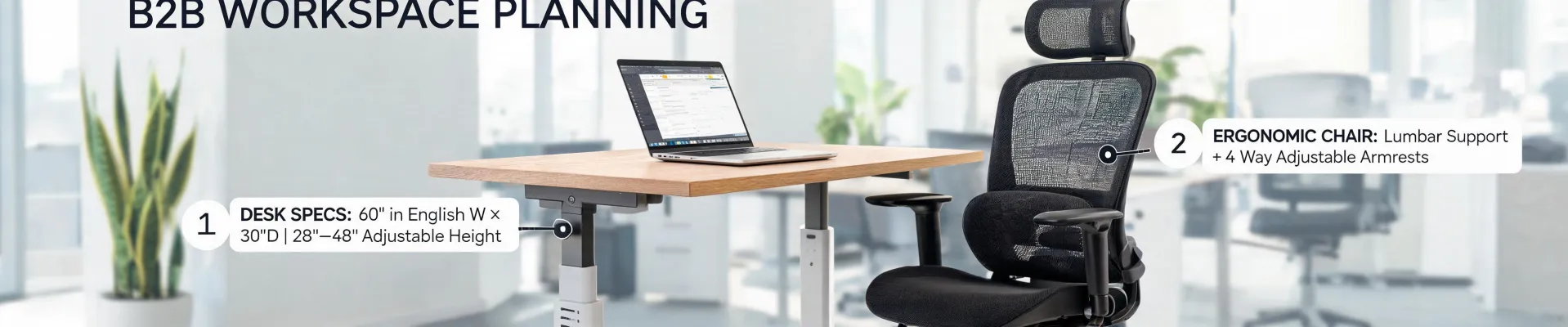
I didn't fully understand why a decent desk frame matters until a $4,000 pilot order came back with stripped screw holes and a motor that whined on day one. That was March 2023. The vendor's response was "have your maintenance guy re-thread them," which was a lesson in itself: a cheap frame can turn into an expensive project.
Since then, I've tracked every piece of office furniture we buy in a cost system that includes assembly labor, warranty calls, and replacement cycles. Over the past six years, that covers roughly $180,000 in spend. The biggest pattern isn't about which vendor is cheapest. It's about which configuration actually gets used in the real office environment.
The question isn't "Is the Fully Jarvis standing desk any good?" It is. The more useful question is "Which Jarvis should I order?" Because there are at least three different situations where the answer is different.
Three Desk-Buying Scenarios
When you look at an office, the needs split roughly into three buckets:
- Shared workstations nobody truly owns.
- Client-facing spaces where design sets the tone.
- Back offices where desks are tools, not statements.
Once you know which bucket dominates, specs start to pick themselves.
Scenario A: The Shared Desk Pool
If your office has hot-desking or teams that book a space by the day, the people using the desk are never going to treat it like their own. That's not a complaint; it's a fact. Users adjust the height often, drag monitors, and leave the occasional coffee ring.
In this setting, I'd pick a durable laminate top over bamboo. Let me explain, because Fully's bamboo top is one of its most appealing sustainable features. But in a high-turnover environment, laminate cleans up faster and hides occasional mishandling better than natural wood. Bamboo can still work if your company wants a visible sustainability message; just be realistic about regular wear. Instead of spending money on a premium top, spend it on a sturdy cable tray and a small power grommet. Those matter more to a rotating crew than a wood finish.
For shape, go with a 48" x 27" rectangle unless the desk will regularly hold two monitors. If it will, a 60" wide laminate top is safer. Just remember that a wider desk in a shared pool takes up more floor and forces more layout constraints. Avoid L-shapes here. They're harder to clean around, harder to claim by a walk-in user, and the extra wings often become dumping grounds.
Controller choice? Keep it simple. The standard remote is enough for a shared desk because each user sets a new height anyway. Memory presets are useful, but they add complexity for someone who just walks up and wants to stand for 30 minutes.
The money-saving move: skip the extra premium colors and extended height range unless you know a specific employee needs them. Let the maintenance crew handle occasional loose bolts.
Scenario B: The Client-Facing Space — And Why Jarvis Aesthetics Can Be Worth the Upgrade
Then there's the design-driven scenario. If your office is an architecture studio, a law firm, or an agency that hosts clients, the desk you sit behind says something before your first sentence. This is where Fully Jarvis standing desk aesthetics genuinely matter.
In a client-facing office, I would not order the utilitarian rectangle. I'd invest in a larger surface—60" or 72" wide—and choose bamboo or a hardwood depending on the room's palette. The Jarvis hardwood line photographs well, and the desktop texture is visible to anyone who walks in. Clients notice the difference between a real wood top and a plastic laminate.
Bamboo is a nice middle ground because it gives you sustainability messaging without going into dark walnut territory. If you want a more executive feel, walnut or other hardwood adds presence. Both show grain, and grain reads as quality. You are buying aesthetics, but in a meeting room, aesthetics are not a luxury; they're part of your brand function.
Don't stop at the top in this scenario. Add a memory controller. If clients or executives share the room, it makes transitioning between sitting and standing less awkward. Consider an L-shape if the office uses a corner as a command station. A good L-shape gives you extra space without looking like two standard desks joined by accident.
Here, cable management is not optional. Visible cords under a beautiful hardwood top ruin the visual. I'd include the fully integrated cable tray and think about how the underside looks in a glass-walled conference room. That's an aesthetic detail people forget until it's too late.
Scenario C: The Lean Back-Office
Now, the third reality. Sometimes the desk sits in a windowless room, and no client is ever going to walk in. The only requirements are that it lifts, it stays stable, and it doesn't wreck the department budget.
In this scenario, I like the Jarvis frame-only option. The frame is the part that truly does the work—the motor, legs, and height mechanism. Pair it with a simple tabletop from a local supplier or a basic laminate top from Fully. That isn't a cheap trick; it's an efficient allocation of spend. A reliable frame matters more than a branded tabletop if the desktop will be covered by paperwork anyway.
Keep the footprint compact. A 48" or 60" top is enough for a single user. Don't order the upgraded controller or Bluetooth features—nobody needs them in a back office. If you want to feel generous, invest what you saved in a good monitor arm or an under-desk keyboard tray. Those have a bigger impact on daily comfort than a walnut surface.
One caveat: check warranty coverage when you buy the frame separately. A frame-only order is covered, but the top you source yourself might not be. That's an acceptable trade if you're matching the desk to an existing top or cutting costs intentionally.
How To Tell Which Scenario Your Office Is In
If you're not sure where your office fits, use these quick filters:
- Do clients, investors, or outside partners ever sit at a desk in your office? If yes, lean toward Scenario B for those rooms.
- Do employees have an assigned desk, or is it first-come, first-served? Assigned desks give you room to personalize specs. Shared desks stretch, so choose durability and simplicity.
- Does your facility have someone available for repairs? If not, a stronger warranty and direct manufacturer support from the official site is worth more than a slightly lower cost elsewhere.
This worked for us, but we're a mid-size firm with predictable office layouts. If you're a seasonal business with headcount spikes, your answer may be hybrid: put premium Jarvis desks in the permanent rooms, and more utilitarian options in the overflow space.
The Cost Side: Don't Use a Calculator To Justify Price
A lot of standing-desk advice compares sticker prices and stops. That's a mistake. Instead, estimate total cost over five years: base price plus delivery, installation labor, expected repair cost, and possible disposal. This is where online calculators are useful, but they are only as good as the inputs you give them.
If you are comparing lease options, a rent vs buy calculator can show whether a monthly payment beats a lump sum once you factor in your company's discount rate. If you have leftover budget after deciding specs, a simple remainder calculator helps decide whether you can afford accessories without chasing a new approval. And yes, you can joke about using a scrap gold calculator to value old desks when you replace them. The number will be laughably low. That low residual value tells you a desk should be evaluated for its useful life, not its resale value.
A $700 desk that lasts eight years with a responsive warranty is a better buy than a $500 desk that fails in two years and has no service line.
Start With the Official Configurator — But Know What You Need First
When you're browsing the Fully Jarvis standing desk official site, it's easy to get hypnotized by options. Stainless steel, powder-coated frames, bamboo, walnut, memory controllers—every upgrade is tempting. But if you're the one approving the invoice, that temptation can erode the value of a thoughtful procurement plan.
Start with the scenario that matches your office. Then use the configurator to build only the features that serve that scenario. For high-turnover spaces: laminate, rectangle, standard frame. For client-facing: bamboo or hardwood, wider top, memory controller. For lean back-office: frame-only or entry-level laminate, and no unnecessary bells.
As of March 2025, these recommendations align with what I see on the Fully site and in our own purchase history. Model names, pricing, and promo options change faster than anyone wants, so verify current details before you send the PO.
Buy the right configuration, and the Jarvis is easy to justify. Buy the wrong one, and you'll be explaining the upgrade request to finance—and to yourself.
