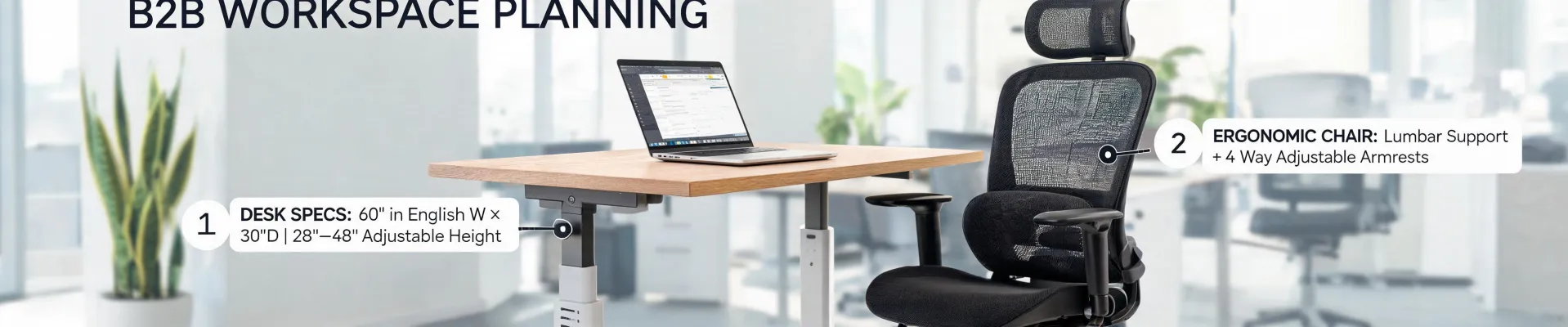
There's no one-size-fits-all answer when it comes to standing desks. I've learned that the hard way — after ordering the wrong size for a team of eight, then spending a weekend rearranging furniture. If you're searching for "Fully Jarvis standing desk price 2025" or trying to decide between bamboo and laminate, you're probably in the same boat: wanting the right desk, but not sure which variant actually fits your office.
Let's break it into three common scenarios. See which one matches your situation, then jump to that section.
Scenario A: You prioritize sustainability and want a natural look
You're the kind of buyer who checks material sourcing. Maybe your company has a green procurement policy, or you just like the warmth of real wood. The Fully Jarvis Bamboo standing desk is your strongest option — but only if you're willing to accept a few trade-offs.
Bamboo is technically a grass, not a hardwood. It's renewable, grows fast, and looks great in open-plan offices. I switched to bamboo for our HQ after the VP of Sustainability asked for a report on our furniture's carbon footprint. The Jarvis bamboo line uses strand-woven bamboo, which is denser and more durable than standard bamboo — but it's still not as scratch-resistant as laminate. If your team eats lunch at their desks (which mine does), expect light surface marks after a year or two. That's not a defect; it's a characteristic of natural material.
Per FTC Green Guides (ftc.gov), environmental claims like "recyclable" or "sustainable" need substantiation. Fully publishes their bamboo sourcing info on their site — I verified it before our purchase. But don't expect a full lifecycle analysis unless you ask.
Price-wise, for 2025: the bamboo frame-only option starts around $550, and a full desk with a bamboo top runs $700–900 depending on size. That's in line with what I've seen in our purchasing system over the past 3 years — prices went up about 8% from 2023.
Scenario B: You need to fit the desk into a tight or irregular space
Not every office has a standard 60" x 30" footprint. I once had to order desks for a converted conference room that was barely 8 feet wide. The L-shaped Jarvis saved us — but only because I measured twice first.
Here's where practical measuring matters. If you're asking "how to read a ruler" correctly (and I've had to re-train new hires on this), remember: the smallest marks on a standard ruler are 1/16 of an inch. For desk placement, you don't need that precision — 1/4 inch is fine. But do measure the room's doorways and elevator dimensions too. A Jarvis L-shaped desk has two pieces: a 60" main section and a 48" return. I learned the hard way that our building's service elevator only allows 72" diagonally — we had to tilt the box and shuffle it in.
Also, think about what goes on the desk. A standard A4 paper ream is 8.3" x 11.7" — you'll want at least 12" of depth in front of your monitor for paperwork. If your team handles large documents (like blueprints or legal pads), bump up to the 30" depth option. The Jarvis comes in 27" and 30" depths. I'd recommend 30" for any desk that will see multi-tasking.
Oh, and regarding the eigenvector calculator you might have in your search history — I assume someone on your team needs to do matrix math. That's fine, but the desk itself doesn't need special features for that. Any stable surface works. The Jarvis is rated for 350 lbs, so even carrying a heavy workstation plus a few textbooks won't be an issue.
Scenario C: You're budget-conscious but don't want to sacrifice quality
Let's be real: not every department can justify $800+ per desk. If your finance team is pressuring you to keep per-desk costs under $500, here's what I'd do: go with the Jarvis frame only (around $450–550) and source your own top from a local lumber yard. You can get a 60" x 30" piece of maple butcher block for about $120, sand and seal it yourself, and end up with a custom desk that looks premium. I did this for our design team last year — total cost per desk was $570, and they loved being able to choose the wood grain.
But don't skip the frame. I've seen cheap frames wobble when a monitor is pushed. The Jarvis frame has a 15-year warranty (though I should note: that's the frame-only, not the motor). In my experience, buying a cheap frame to save $200 is a false economy — you'll spend more on replacement or lost productivity from a shaky desk.
For 2025 pricing: I'm tracking a potential small increase due to tariffs on imported steel. If you can, order before April 2025. That's just my guess based on vendor calls — don't hold me to it.
How to decide which scenario fits you
Ask yourself three questions:
- Does your company have a formal sustainability goal? If yes, go Scenario A (bamboo). If no, consider budget or space constraints first.
- Is the desk going into a shared space or a private office? Shared spaces need durability — laminate or hard maple might outlast bamboo. Private offices can handle the softer surface of bamboo.
- How many people will use the desk daily? Single user: any option works. Hot-desked: the laminate top resists stains better — less maintenance for your facilities team.
My advice? Order one desk first. Test it on a real employee for a week. I did that with our first Jarvis — put it in the quiet corner for anyone to try. After 7 days, 12 people had signed up wanting their own. But that trial also revealed we needed the wider 30" depth, which I hadn't accounted for. That kind of upfront verification beats ordering 20 desks and then swapping half of them.
5 minutes of verification beats 5 days of correction — I've got the invoice evidence to prove it.
